
When 2.00 mol of SO2Cl2 is placed in a 2.00-L flask at 303 K, 56% of the SO2Cl2 decomposes to SO2 and Cl2: SO2Cl2(g) ⇌ SO2(g) + Cl2(g) (c) According to Le Châtelier's principle, would the percent of SO2Cl2 that decomposes increase, decrease or stay the same if the mixture were transferred to a 15.00-L vessel?
Ch.15 - Chemical Equilibrium
15장, 문제 75
The value of the equilibrium constant Kc for the reaction N2(g) + 3 H2(g) ⇌ 2 NH3(g) changes in the following manner as a function of temperature: Temperature (°C) Kc 300 9.6 400 0.50 500 0.058. (b) Use the standard enthalpies of formation given in Appendix C to determine the ΔH for this reaction at standard conditions. Does this value agree with your prediction from part (a)?
검증된 단계별 안내1
Step 1: Write the balanced chemical equation for the reaction: \( N_2(g) + 3 H_2(g) \rightleftharpoons 2 NH_3(g) \).
Step 2: Use the standard enthalpies of formation (\( \Delta H_f^\circ \)) from Appendix C to calculate the \( \Delta H^\circ \) for the reaction. The formula is: \( \Delta H^\circ = \sum \Delta H_f^\circ (\text{products}) - \sum \Delta H_f^\circ (\text{reactants}) \).
Step 3: Substitute the standard enthalpies of formation for \( NH_3(g) \), \( N_2(g) \), and \( H_2(g) \) into the equation. Remember that the \( \Delta H_f^\circ \) for elements in their standard state, like \( N_2(g) \) and \( H_2(g) \), is zero.
Step 4: Calculate the \( \Delta H^\circ \) for the reaction using the values from Step 3. This will give you the enthalpy change for the reaction under standard conditions.
Step 5: Compare the calculated \( \Delta H^\circ \) with your prediction from part (a) regarding the temperature dependence of \( K_c \). If \( K_c \) decreases with increasing temperature, the reaction is exothermic, and the calculated \( \Delta H^\circ \) should be negative.
주요 개념
질문에 올바르게 답하기 위해 반드시 이해해야 하는 핵심 개념들은 다음과 같습니다.
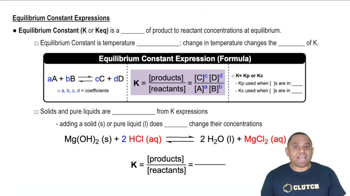
Equilibrium Constant (Kc)
The equilibrium constant, Kc, quantifies the ratio of the concentrations of products to reactants at equilibrium for a given reaction at a specific temperature. It is a dimensionless value that reflects the extent to which a reaction proceeds. A higher Kc indicates a greater concentration of products at equilibrium, while a lower Kc suggests that reactants are favored. Understanding how Kc varies with temperature is crucial for predicting reaction behavior.
추천 영상:
가이드 코스
Equilibrium Constant Expressions
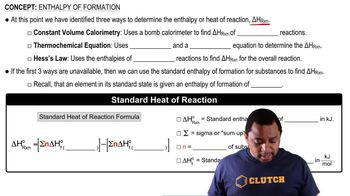
Standard Enthalpy of Formation (ΔHf)
The standard enthalpy of formation (ΔHf) is the change in enthalpy when one mole of a compound is formed from its elements in their standard states. It is a key concept in thermodynamics that helps in calculating the overall enthalpy change (ΔH) for a reaction. By using the standard enthalpies of formation of the reactants and products, one can determine whether a reaction is exothermic or endothermic, which is essential for understanding the energy dynamics of the reaction.
추천 영상:
가이드 코스
Enthalpy of Formation
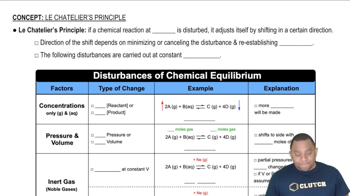
Le Chatelier's Principle
Le Chatelier's Principle states that if a dynamic equilibrium is disturbed by changing the conditions, the system will adjust to counteract the change and restore a new equilibrium. This principle is particularly relevant when considering how temperature changes affect the equilibrium constant Kc. For exothermic reactions, increasing temperature typically decreases Kc, while for endothermic reactions, it increases Kc. This understanding aids in predicting the direction of shifts in equilibrium based on temperature variations.
추천 영상:
가이드 코스
Le Chatelier's Principle
관련 실천
교과서 질문
557
views
교과서 질문
A sample of nitrosyl bromide (NOBr) decomposes according to the equation 2 NOBr(𝑔) ⇌ 2 NO(𝑔) + Br2(𝑔) An equilibrium mixture in a 5.00-L vessel at 100°C contains 3.22 g of NOBr, 3.08 g of NO, and 4.19 g of Br2. (b) What is the total pressure exerted by the mixture of gases?
1082
views
교과서 질문
When 2.00 mol of SO2Cl2 is placed in a 2.00-L flask at 303 K, 56% of the SO2Cl2 decomposes to SO2 and Cl2: SO2Cl2(g) ⇌ SO2(g) + Cl2(g) (a) Calculate Kc for this reaction at this temperature.
1261
views
1
rank
교과서 질문
A sample of nitrosyl bromide (NOBr) decomposes according to the equation 2 NOBr(g) ⇌ 2 NO(g) + Br2(g) An equilibrium mixture in a 5.00-L vessel at 100°C contains 3.22 g of NOBr, 3.08 g of NO, and 4.19 g of Br2. (c) What was the mass of the original sample of NOBr?
1100
views
