
Ch.15 - Chemical Equilibrium
Brown - Chemistry: The Central Science 14th Edition
Brown14th EditionChemistry: The Central ScienceISBN: 9780134414232당신이 사용하는 게 아니라요?교과서 변경
15장, 문제 7b

When lead(IV) oxide is heated above 300°C, it decomposes according to the reaction, 2 PbO2(𝑠)⇌2PbO(𝑠)+O2(𝑔). Consider the two sealed vessels of PbO2 shown here. If both vessels are heated to 400°C and allowed to come to equilibrium, which of the following statements is or are true?
b. There will be less PbO2 remaining in vessel B,

검증된 단계별 안내
1
Step 1: Understand the chemical reaction involved. The decomposition of lead(IV) oxide (PbO_2) into lead(II) oxide (PbO) and oxygen gas (O_2) is given by the equation: 2 PbO_2(s) ⇌ 2 PbO(s) + O_2(g).
Step 2: Recognize that the reaction is at equilibrium. At equilibrium, the rate of the forward reaction (decomposition of PbO_2) equals the rate of the reverse reaction (formation of PbO_2 from PbO and O_2).
Step 3: Consider the effect of temperature. Both vessels are heated to 400°C, which is above the decomposition temperature of PbO_2, allowing the reaction to proceed towards equilibrium.
Step 4: Analyze the initial conditions in both vessels. If vessel B initially contains more PbO_2 than vessel A, the amount of PbO_2 that decomposes will depend on the initial amount present and the equilibrium constant at 400°C.
Step 5: Apply Le Chatelier's Principle. If vessel B has a different initial condition (e.g., more PbO_2), the system will adjust to reach equilibrium, potentially resulting in different amounts of PbO_2 remaining compared to vessel A.

비슷한 문제에 대한 검증된 영상 답변:

이 영상 해법은 위 문제에 도움이 된다고 튜터들이 추천한 것입니다.
영상 길이:
57s

주요 개념

질문에 올바르게 답하기 위해 반드시 이해해야 하는 핵심 개념들은 다음과 같습니다.

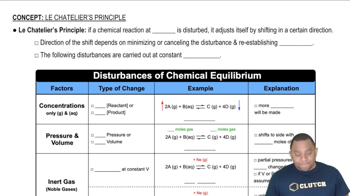
Le Chatelier's Principle

Le Chatelier's Principle states that if a dynamic equilibrium is disturbed by changing the conditions, the position of equilibrium shifts to counteract the change. In the context of the decomposition of lead(IV) oxide, increasing the temperature will favor the endothermic reaction, shifting the equilibrium towards the products (PbO and O2), thus reducing the amount of PbO2 present.
추천 영상:
가이드 코스
07:32
Le Chatelier's Principle

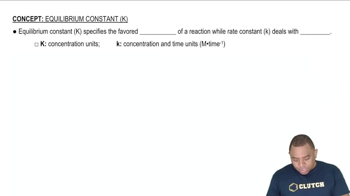
Equilibrium Constant (K)

The equilibrium constant (K) quantifies the ratio of the concentrations of products to reactants at equilibrium for a given reaction at a specific temperature. For the decomposition of PbO2, the value of K will change with temperature, influencing how much PbO2 remains in each vessel after heating. A higher temperature typically increases K for endothermic reactions, indicating more products are formed.
추천 영상:
가이드 코스
01:14
Equilibrium Constant K

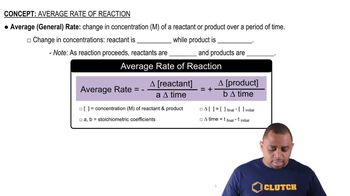
Effect of Temperature on Reaction Rates

Temperature affects the rate of chemical reactions, with higher temperatures generally increasing reaction rates. In the case of the decomposition of PbO2, heating to 400°C accelerates the reaction, leading to a faster conversion of PbO2 to PbO and O2. This increased rate of reaction is crucial for understanding why vessel B, if designed differently (e.g., with more surface area or different conditions), may have less PbO2 remaining compared to vessel A.
추천 영상:
가이드 코스
02:03
Average Rate of Reaction