Ch.15 - Chemical Equilibrium
Brown - Chemistry: The Central Science 14th Edition
Brown14th EditionChemistry: The Central ScienceISBN: 9780134414232당신이 사용하는 게 아니라요?교과서 변경
15장, 문제 19c

Which of the following statements are true and which are false? (c) As the value of the equilibrium constant increases, the speed at which a reaction reaches equilibrium must increase.

검증된 단계별 안내
1
Step 1: Understand the concept of equilibrium constant (K). The equilibrium constant is a measure of the ratio of the concentrations of products to reactants at equilibrium. It does not depend on the initial concentrations of reactants or products and is only affected by temperature.
Step 2: Understand the concept of reaction rate. The speed at which a reaction reaches equilibrium is determined by the reaction rate, not the equilibrium constant. The reaction rate is influenced by factors such as temperature, concentration, and the presence of a catalyst.
Step 3: Analyze the statement. The statement suggests that as the value of the equilibrium constant increases, the speed at which a reaction reaches equilibrium must increase. This is implying a direct relationship between the equilibrium constant and the reaction rate.
Step 4: Evaluate the statement. The equilibrium constant (K) and the reaction rate are independent of each other. A larger equilibrium constant means the reaction favors the products at equilibrium, but it does not necessarily mean the reaction will reach equilibrium faster.
Step 5: Conclude the statement. Therefore, the statement is false. The speed at which a reaction reaches equilibrium (reaction rate) is not directly related to the value of the equilibrium constant.

비슷한 문제에 대한 검증된 영상 답변:

이 영상 해법은 위 문제에 도움이 된다고 튜터들이 추천한 것입니다.
영상 길이:
2m

주요 개념

질문에 올바르게 답하기 위해 반드시 이해해야 하는 핵심 개념들은 다음과 같습니다.

Equilibrium Constant (K)

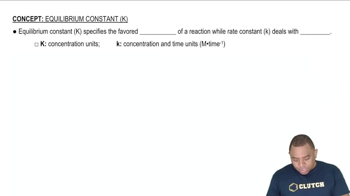
The equilibrium constant (K) is a numerical value that expresses the ratio of the concentrations of products to reactants at equilibrium for a reversible chemical reaction. A larger K value indicates a greater concentration of products at equilibrium, suggesting that the reaction favors product formation. However, K does not provide information about the rate at which equilibrium is achieved.
추천 영상:
가이드 코스
01:14
Equilibrium Constant K

Reaction Rate

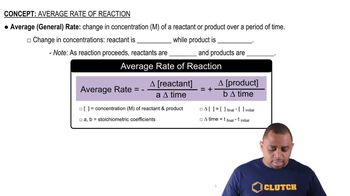
The reaction rate refers to the speed at which reactants are converted into products in a chemical reaction. It is influenced by factors such as concentration, temperature, and the presence of catalysts. While the equilibrium constant indicates the position of equilibrium, it does not directly correlate with how quickly a reaction reaches that state.
추천 영상:
가이드 코스
02:03
Average Rate of Reaction

Dynamic Equilibrium

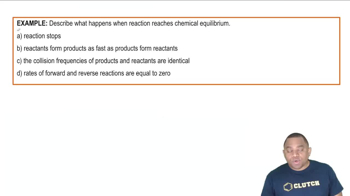
Dynamic equilibrium occurs in a reversible reaction when the rates of the forward and reverse reactions are equal, resulting in constant concentrations of reactants and products. This state does not imply that the reaction has stopped; rather, it continues to occur in both directions at equal rates. The time taken to reach this equilibrium can vary independently of the equilibrium constant.
추천 영상:
가이드 코스
01:18
Chemical Equilibrium Example