
교과서 질문
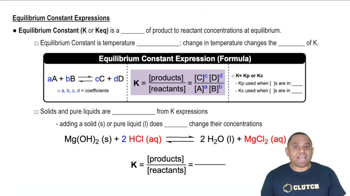
The equilibrium constant for the dissociation of molecular iodine, I2(g) ⇌ 2 I(g), at 800 K is Kc = 3.1 × 10⁻⁵. (a) Which species predominates at equilibrium I2 or I?

 검증된 단계별 안내
 03:20
03:20
 03:05
03:05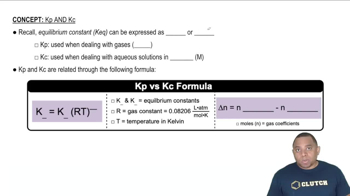 02:06
02:06The equilibrium constant for the dissociation of molecular iodine, I2(g) ⇌ 2 I(g), at 800 K is Kc = 3.1 × 10⁻⁵. (a) Which species predominates at equilibrium I2 or I?
Write the expressions for 𝐾𝑐 for the following reactions. In each case indicate whether the reaction is homogeneous or heterogeneous.
(b) Ti(𝑠) + 2Cl2(𝑔) ⇌ TiCl4(𝑙)
The equilibrium constant for the dissociation of molecular iodine, I2(g) ⇌ 2 I(g), at 800 K is Kc = 3.1×10⁻⁵. (b) Assuming both forward and reverse reactions are elementary reactions, which reaction has the larger rate constant, the forward or the reverse reaction?
Write the expression for Kc for the following reactions. In each case indicate whether the reaction is homogeneous or heterogeneous.
(a) 3 NO(g) ⇌ N2O(g) + NO2(g)
(b) CH4(g) + 2 H2S(g) ⇌ CS2(g) + 4 H2(g)
(c) Ni(CO)4(g) ⇌ Ni(s) + 4 CO(g)
(d) HF(aq) ⇌ H+(aq) + F-(aq)
(e) 2Ag(s) + Zn2+(aq) ⇌ 2 Ag+(aq) + Zn(s)
(f) H2O(l) ⇌ H+(aq) + OH-(aq)
(g) 2 H2O(l) ⇌ 2 H+(aq) + 2 OH-(aq)
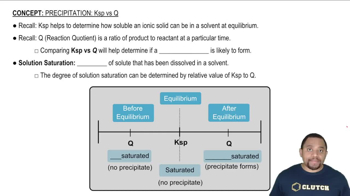
Which of the following reactions lies to the right, favoring the formation of products, and which lies to the left, favoring the formation of reactants?
(a) 2 NO(g) + O2(g) ⇌ 2 NO2(g) Kp = 5.0 × 10¹²
(b) 2 HBr(g) ⇌ H2(g) + Br2(g) Kc = 5.8×10⁻¹⁸