
Pyridinium bromide 1C5H5NHBr2 is a strong electrolyte that dissociates completely into C5H5NH+ and Br-. An aqueous solution of pyridinium bromide has a pH of 2.95. (c) A solution of pyridinium bromide has a pH of 2.95. What is the concentration of the pyridinium cation at equilibrium, in units of molarity?
Ch.16 - Acid-Base Equilibria
16장, 문제 81
A solution of sodium acetate (NaCH3COO) has a pH of 9.70. What is the molarity of the solution?
검증된 단계별 안내1
Step 1: Recognize that sodium acetate (NaCH3COO) is a salt that can hydrolyze in water to form acetic acid (CH3COOH) and hydroxide ions (OH^-), which makes the solution basic.
Step 2: Use the given pH to find the pOH of the solution. Recall that pH + pOH = 14, so pOH = 14 - pH.
Step 3: Calculate the hydroxide ion concentration [OH^-] using the formula [OH^-] = 10^{-pOH}.
Step 4: Write the hydrolysis equation for sodium acetate: CH3COO^- + H2O \(\rightleftharpoons\) CH3COOH + OH^-. Use the equilibrium expression K_b = \(\frac{[CH3COOH][OH^-]}{[CH3COO^-]}\) to relate the concentrations.
Step 5: Use the known value of K_w (1.0 \(\times\) 10^{-14}) and the K_a of acetic acid to find K_b for acetate ion: K_b = \(\frac{K_w}{K_a}\). Then, solve for the initial concentration of CH3COO^- using the equilibrium expression and the calculated [OH^-].
주요 개념
질문에 올바르게 답하기 위해 반드시 이해해야 하는 핵심 개념들은 다음과 같습니다.
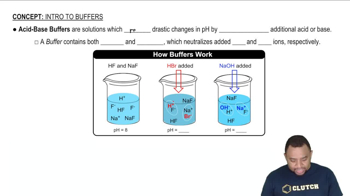
Buffer Solutions
A buffer solution is a system that resists changes in pH upon the addition of small amounts of acid or base. Sodium acetate, being the salt of a weak acid (acetic acid) and a strong base (sodium hydroxide), acts as a buffer. This property is crucial for understanding how the pH of the solution can remain stable despite the presence of weak acids or bases.
추천 영상:
가이드 코스
Buffer Solutions
pH and pKa Relationship
The pH of a solution is a measure of its acidity or basicity, defined as the negative logarithm of the hydrogen ion concentration. The pKa is the negative logarithm of the acid dissociation constant (Ka) and indicates the strength of an acid. In buffer solutions, the Henderson-Hasselbalch equation relates pH, pKa, and the ratio of the concentrations of the conjugate base and acid, which is essential for calculating molarity.
추천 영상:
가이드 코스
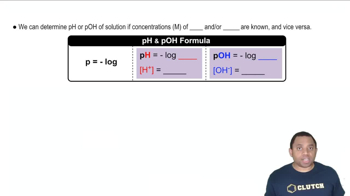
pH and pOH Calculations
Molarity Calculation
Molarity is defined as the number of moles of solute per liter of solution. To find the molarity of sodium acetate in the solution, one can use the pH to determine the concentration of acetate ions and apply the Henderson-Hasselbalch equation. This calculation is fundamental in determining how much solute is present in a given volume of solution, which is key to answering the question.
추천 영상:
가이드 코스
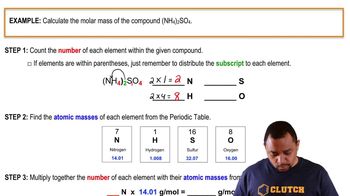
Molar Mass Calculation Example
관련 실천
교과서 질문
457
views
교과서 질문
Using data from Appendix D, calculate 3OH-4 and pH for each of the following solutions: (b) 0.035 M Na2S
616
views
교과서 질문
Pyridinium bromide 1C5H5NHBr2 is a strong electrolyte that dissociates completely into C5H5NH+ and Br-. An aqueous solution of pyridinium bromide has a pH of 2.95. (b) Using Appendix D, calculate the Ka for pyridinium bromide.
577
views
교과서 질문
Which is the stronger acid, the ammonium ion or the hydroxylammonium ion?
1
views
교과서 질문
Pyridinium bromide 1C5H5NHBr2 is a strong electrolyte that dissociates completely into C5H5NH+ and Br-. An aqueous solution of pyridinium bromide has a pH of 2.95. (a) Write out the reaction that leads to this acidic pH.
844
views
1
rank
