Ch.16 - Acid-Base Equilibria
Brown - Chemistry: The Central Science 14th Edition
Brown14th EditionChemistry: The Central ScienceISBN: 9780134414232당신이 사용하는 게 아니라요?교과서 변경
16장, 문제 85

An unknown salt is either NaF, NaCl, or NaOCl. When 0.050 mol of the salt is dissolved in water to form 0.500 L of solution, the pH of the solution is 8.08. What is the identity of the salt?

검증된 단계별 안내
1
Determine the nature of each salt in terms of its ability to affect the pH of a solution. NaF is a salt formed from a strong base (NaOH) and a weak acid (HF), NaCl comes from a strong base (NaOH) and a strong acid (HCl), and NaOCl is formed from a strong base (NaOH) and a weak acid (HOCl).
Understand that NaCl, being a neutral salt from a strong acid and strong base, does not affect the pH of the solution. It will remain neutral at pH 7.
Recognize that NaF will hydrolyze in water because it is a salt of a weak acid. The fluoride ion (F-) will react with water to form HF and OH- (hydroxide ions), making the solution basic.
Consider that NaOCl will also hydrolyze in water. The hypochlorite ion (OCl-) will react with water to form HOCl and OH-, increasing the pH of the solution.
Compare the pH of the solution (8.08) to typical pH values expected from these reactions. A pH of 8.08 suggests a weakly basic solution, which aligns with the hydrolysis of either NaF or NaOCl. Determine which of these salts, when hydrolyzed, would most closely produce a pH of 8.08.

비슷한 문제에 대한 검증된 영상 답변:

이 영상 해법은 위 문제에 도움이 된다고 튜터들이 추천한 것입니다.
영상 길이:
11m

주요 개념

질문에 올바르게 답하기 위해 반드시 이해해야 하는 핵심 개념들은 다음과 같습니다.

pH and pOH

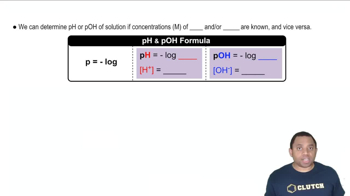
pH is a measure of the acidity or basicity of a solution, defined as the negative logarithm of the hydrogen ion concentration. A pH of 7 is neutral, below 7 is acidic, and above 7 is basic. The pOH is related to pH through the equation pH + pOH = 14, which helps in understanding the balance of hydroxide and hydrogen ions in the solution.
추천 영상:
가이드 코스
02:09
pH and pOH Calculations

Salt Hydrolysis

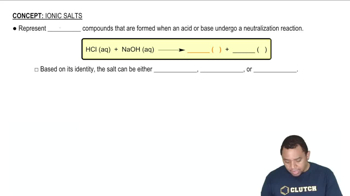
Salt hydrolysis occurs when an ionic compound dissolves in water and reacts with water to produce either acidic or basic solutions. The nature of the ions from the salt determines whether the solution will be acidic, neutral, or basic. For example, NaF produces fluoride ions that can react with water to form hydroxide ions, leading to a basic solution.
추천 영상:

Identifying Ions in Salts

Identifying the ions present in a salt is crucial for determining its properties in solution. In this case, NaF, NaCl, and NaOCl dissociate into different ions: NaF yields Na+ and F-, NaCl yields Na+ and Cl-, and NaOCl yields Na+ and OCl-. The behavior of these ions in water, particularly their ability to affect pH, helps in identifying the unknown salt based on the measured pH.
추천 영상: