
Ch.16 - Acid-Base Equilibria
Brown - Chemistry: The Central Science 14th Edition
Brown14th EditionChemistry: The Central ScienceISBN: 9780134414232당신이 사용하는 게 아니라요?교과서 변경
16장, 문제 67a

Consider the base hydroxylamine, NH2OH. (a) What is the conjugate acid of hydroxylamine?

검증된 단계별 안내
1
Identify the base in the problem: hydroxylamine, which is NH2OH.
Recall the concept of a conjugate acid: it is formed when a base gains a proton (H+).
Add a proton (H+) to the base NH2OH. This involves adding an H+ ion to the nitrogen atom, which is the site of protonation.
Write the chemical formula of the conjugate acid: NH3OH+.
Verify the charge balance: The original base NH2OH is neutral, and after gaining a proton, the conjugate acid NH3OH+ has a positive charge.

비슷한 문제에 대한 검증된 영상 답변:

이 영상 해법은 위 문제에 도움이 된다고 튜터들이 추천한 것입니다.
영상 길이:
1m

주요 개념

질문에 올바르게 답하기 위해 반드시 이해해야 하는 핵심 개념들은 다음과 같습니다.

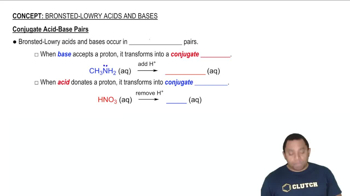
Conjugate Acid-Base Pairs

In acid-base chemistry, a conjugate acid is formed when a base accepts a proton (H+). This concept is essential for understanding how substances interact in chemical reactions, particularly in Brønsted-Lowry acid-base theory, which defines acids as proton donors and bases as proton acceptors.
추천 영상:
가이드 코스
01:30
Conjugate Acid-Base Pairs

Protonation

Protonation is the process by which a molecule gains a proton, resulting in the formation of a conjugate acid. For hydroxylamine (NH2OH), protonation occurs at the nitrogen atom, which has a lone pair of electrons that can bond with a proton, leading to the formation of its conjugate acid.
추천 영상:
가이드 코스
01:38
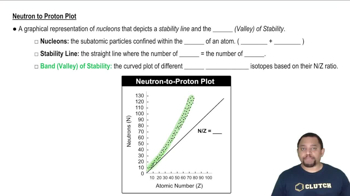
Neutron-to-Proton Plot

Hydroxylamine Structure

Hydroxylamine (NH2OH) consists of an amine group (NH2) and a hydroxyl group (OH). Understanding its molecular structure is crucial for predicting its behavior in acid-base reactions, including how it can act as a base and what its conjugate acid will be when it accepts a proton.
추천 영상:
가이드 코스
01:42
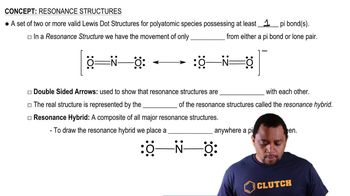
Resonance Structures