Ch.16 - Acid-Base Equilibria
Brown - Chemistry: The Central Science 14th Edition
Brown14th EditionChemistry: The Central ScienceISBN: 9780134414232당신이 사용하는 게 아니라요?교과서 변경
16장, 문제 16b

Give the conjugate acid of the following Brønsted–Lowry bases: (i) SO42-, (ii) CH3NH2.

검증된 단계별 안내
1
Identify the Brønsted–Lowry base in each case. A Brønsted–Lowry base is a species that can accept a proton (H⁺).
For each base, add a proton (H⁺) to form the conjugate acid. This involves increasing the hydrogen count by one and adjusting the charge accordingly.
For (i) SO₄²⁻, add H⁺ to form HSO₄⁻. The sulfate ion (SO₄²⁻) accepts a proton to become the hydrogen sulfate ion (HSO₄⁻).
For (ii) CH₃NH₂, add H⁺ to form CH₃NH₃⁺. The methylamine (CH₃NH₂) accepts a proton to become the methylammonium ion (CH₃NH₃⁺).
Verify that the resulting species have the correct charge and structure to ensure they are the conjugate acids of the given bases.

비슷한 문제에 대한 검증된 영상 답변:

이 영상 해법은 위 문제에 도움이 된다고 튜터들이 추천한 것입니다.
영상 길이:
2m

주요 개념

질문에 올바르게 답하기 위해 반드시 이해해야 하는 핵심 개념들은 다음과 같습니다.

Brønsted–Lowry Theory

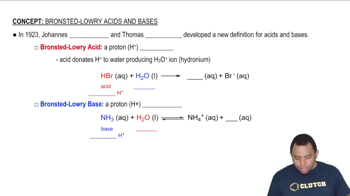
The Brønsted–Lowry theory defines acids as proton donors and bases as proton acceptors. This framework allows us to understand acid-base reactions in terms of the transfer of protons (H+ ions). In this context, identifying the conjugate acid of a base involves determining what species is formed when the base accepts a proton.
추천 영상:
가이드 코스
02:08
Bronsted-Lowry Acid-Base Theory

Conjugate Acid-Base Pairs

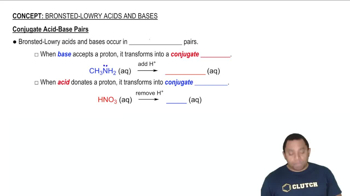
Conjugate acid-base pairs consist of two species that differ by the presence of a proton. When a base gains a proton, it becomes its conjugate acid, while the acid that donates the proton becomes its conjugate base. Understanding these pairs is essential for predicting the outcome of acid-base reactions and for identifying the conjugate acids of given bases.
추천 영상:
가이드 코스
01:30
Conjugate Acid-Base Pairs

Examples of Conjugate Acids

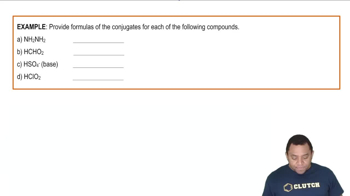
To find the conjugate acids of specific bases, one must consider the chemical structure of the base. For instance, when the sulfate ion (SO4^2-) accepts a proton, it becomes hydrogen sulfate (HSO4^-). Similarly, when methylamine (CH3NH2) accepts a proton, it forms methylammonium (CH3NH3+). Recognizing these transformations is key to solving the problem.
추천 영상:
가이드 코스
02:04
Conjugate Acids and Bases Example
관련 실천
교과서 질문

The hydrogen sulfite ion 1HSO3-2 is amphiprotic. Write a balanced chemical equation showing how it acts as an acid toward water and another equation showing how it acts as a base toward water.

1348
views

교과서 질문

Give the conjugate base of the following Brønsted–Lowry acids: (i) HIO3, (ii) NH4+.

415
views
교과서 질문

Which of the following statements is false? (a) An Arrhenius base increases the concentration of OH- in water. (b) A Brønsted-Lowry base is a proton acceptor. (c) Water can act as a Brønsted–Lowry acid. (d) Water can act as a Brønsted–Lowry base. (e) Any compound that contains an –OH group acts as a Brønsted-Lowry base.

519
views
교과서 질문

Give the conjugate base of the following Brønsted–Lowry acids: (i) HCOOH, (ii) HPO42-.

511
views
교과서 질문

Identify the Brønsted–Lowry acid and the Brønsted–Lowry base on the left side of each of the following equations, and also identify the conjugate acid and conjugate base of each on the right side:

(a) NH4+(aq) + CN-(aq) ⇌ HCN(aq) + NH3(aq)

(b) (CH3)3N(aq) + H2O(l) ⇌ (CH3)3NH+(aq) + OH-(aq)

(c) HCOOH(aq) + PO43-(aq) ⇌ HCOO-(aq)+ HPO42-(aq)

295
views
교과서 질문

Identify the Brønsted–Lowry acid and the Brønsted– Lowry base on the left side of each equation, and also identify the conjugate acid and conjugate base of each on the right side.

(a) HBrO(aq) + H2O(l) ⇌ H3O+(aq) + BrO-(aq)

(b) HSO4-(aq) + HCO3-(aq) ⇌ SO42-(aq) + H2CO3(aq)

(c) HSO3-(aq) + H3O+(aq) ⇌ H2SO3(aq) + H2O(l)

365
views