Ch.16 - Acid-Base Equilibria
Brown - Chemistry: The Central Science 14th Edition
Brown14th EditionChemistry: The Central ScienceISBN: 9780134414232당신이 사용하는 게 아니라요?교과서 변경
16장, 문제 51

Lactic acid CH3CH(OH)COOH has one acidic hydrogen. A 0.10 M solution of lactic acid has a pH of 2.44. Calculate Ka.

검증된 단계별 안내
1
Identify the given information: The concentration of lactic acid is 0.10 M, and the pH of the solution is 2.44.
Calculate the concentration of hydrogen ions [H⁺] using the pH value: [H⁺] = 10^(-pH). Substitute the given pH value to find [H⁺].
Write the expression for the acid dissociation constant (Ka) for lactic acid: Ka = [H⁺][A⁻]/[HA], where [A⁻] is the concentration of the conjugate base and [HA] is the concentration of the undissociated acid.
Assume that the initial concentration of lactic acid [HA] is 0.10 M and that the change in concentration due to dissociation is equal to [H⁺]. Therefore, [A⁻] = [H⁺] and [HA] = 0.10 - [H⁺].
Substitute the values of [H⁺], [A⁻], and [HA] into the Ka expression and solve for Ka.

주요 개념

질문에 올바르게 답하기 위해 반드시 이해해야 하는 핵심 개념들은 다음과 같습니다.

Acid-Base Equilibrium

Acid-base equilibrium refers to the balance between the concentrations of an acid and its conjugate base in a solution. For weak acids like lactic acid, this equilibrium can be described by the dissociation reaction, where the acid donates a proton (H+) to water, forming its conjugate base and hydronium ions. Understanding this concept is crucial for calculating the acid dissociation constant (Ka).
추천 영상:
가이드 코스
6:47
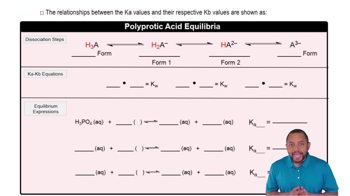
Triprotic Acid Equilibrium

pH and Hydronium Ion Concentration

pH is a measure of the acidity of a solution, defined as the negative logarithm of the hydronium ion concentration (H3O+). A lower pH indicates a higher concentration of H3O+. In this case, the pH of 2.44 corresponds to a specific concentration of hydronium ions, which is essential for determining the degree of dissociation of lactic acid and subsequently calculating Ka.
추천 영상:
가이드 코스
06:25
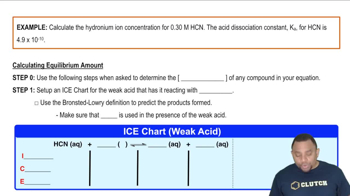
Hydronium Ion Concentration Example

Acid Dissociation Constant (Ka)

The acid dissociation constant (Ka) quantifies the strength of a weak acid in solution. It is defined as the ratio of the concentration of the products (the conjugate base and hydronium ions) to the concentration of the undissociated acid at equilibrium. Calculating Ka involves using the concentrations derived from the initial concentration of the acid and the change in concentration due to dissociation, which is influenced by the pH of the solution.
추천 영상:
가이드 코스
03:50
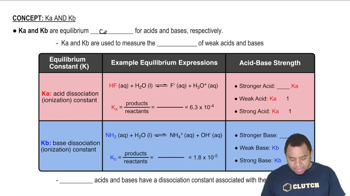
Characteristics of Ka and Kb