Ch.16 - Acid-Base Equilibria
Brown - Chemistry: The Central Science 14th Edition
Brown14th EditionChemistry: The Central ScienceISBN: 9780134414232당신이 사용하는 게 아니라요?교과서 변경
16장, 문제 13

NH31g2 and HCl(g) react to form the ionic solid NH4Cl1s2. Which substance is the Brønsted–Lowry acid in this reaction? Which is the Brønsted–Lowry base?

검증된 단계별 안내
1
Identify the Brønsted–Lowry acid and base definitions: A Brønsted–Lowry acid is a substance that donates a proton (H+), while a Brønsted–Lowry base is a substance that accepts a proton.
Examine the reactants: NH3(g) and HCl(g).
Determine which substance donates a proton: HCl(g) donates a proton to form Cl- and NH4+.
Determine which substance accepts a proton: NH3(g) accepts a proton to form NH4+.
Conclude that HCl(g) is the Brønsted–Lowry acid (proton donor) and NH3(g) is the Brønsted–Lowry base (proton acceptor).

비슷한 문제에 대한 검증된 영상 답변:

이 영상 해법은 위 문제에 도움이 된다고 튜터들이 추천한 것입니다.
영상 길이:
2m
도움이 되었나요?

주요 개념

질문에 올바르게 답하기 위해 반드시 이해해야 하는 핵심 개념들은 다음과 같습니다.

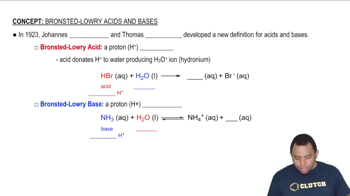
Brønsted–Lowry Acid-Base Theory

The Brønsted–Lowry theory defines acids as proton donors and bases as proton acceptors. In a chemical reaction, the substance that donates a hydrogen ion (H+) is classified as an acid, while the substance that accepts the hydrogen ion is classified as a base. This theory expands the definition of acids and bases beyond just their behavior in water, allowing for a broader understanding of acid-base reactions.
추천 영상:
가이드 코스
02:08
Bronsted-Lowry Acid-Base Theory

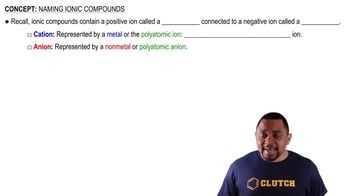
Ionic Compounds

Ionic compounds are formed through the electrostatic attraction between positively charged ions (cations) and negatively charged ions (anions). In the context of the reaction between NH3 and HCl, the product NH4Cl is an ionic compound where NH4+ acts as the cation and Cl- as the anion. Understanding the formation of ionic compounds is essential for analyzing the products of acid-base reactions.
추천 영상:
가이드 코스
02:11
Ionic Compounds Naming

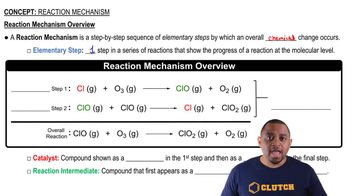
Reaction Mechanism

The reaction mechanism describes the step-by-step process by which reactants transform into products. In the case of NH3 and HCl, the mechanism involves the transfer of a proton from HCl to NH3, resulting in the formation of NH4+ and Cl-. Analyzing the mechanism helps identify the roles of each reactant, clarifying which is the acid and which is the base in the reaction.
추천 영상:
가이드 코스
03:06
Reaction Mechanism Overview