Ch.16 - Acid-Base Equilibria
Brown - Chemistry: The Central Science 14th Edition
Brown14th EditionChemistry: The Central ScienceISBN: 9780134414232당신이 사용하는 게 아니라요?교과서 변경
16장, 문제 88e

Predict the stronger acid in each pair: (e) benzoic acid (C6H5COOH) or phenol (C6H5OH).

검증된 단계별 안내
1
Step 1: Understand the concept of acidity. Acidity is often related to the ability of a compound to donate a proton (H+). The stronger the acid, the more readily it donates a proton.
Step 2: Consider the structure of benzoic acid (C6H5COOH). It contains a carboxylic acid group (-COOH), which is known to be a relatively strong acidic group due to resonance stabilization of its conjugate base (benzoate ion).
Step 3: Consider the structure of phenol (C6H5OH). It contains a hydroxyl group (-OH) attached to an aromatic ring. The phenoxide ion, which is the conjugate base of phenol, is less stabilized by resonance compared to the benzoate ion.
Step 4: Compare the resonance stabilization of the conjugate bases. The benzoate ion (conjugate base of benzoic acid) is more resonance-stabilized than the phenoxide ion (conjugate base of phenol), making benzoic acid a stronger acid.
Step 5: Conclude that benzoic acid (C6H5COOH) is the stronger acid compared to phenol (C6H5OH) due to the greater resonance stabilization of its conjugate base.

비슷한 문제에 대한 검증된 영상 답변:

이 영상 해법은 위 문제에 도움이 된다고 튜터들이 추천한 것입니다.
영상 길이:
1m
도움이 되었나요?

주요 개념

질문에 올바르게 답하기 위해 반드시 이해해야 하는 핵심 개념들은 다음과 같습니다.

Acid Strength

Acid strength refers to the ability of an acid to donate protons (H+) in a solution. Stronger acids have a greater tendency to lose protons, resulting in a higher concentration of H+ ions in solution. This property is often quantified using the acid dissociation constant (Ka), where a larger Ka value indicates a stronger acid.
추천 영상:
가이드 코스
03:51
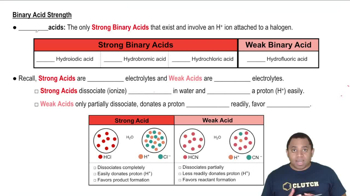
Binary Acid Strengths

Resonance Stabilization

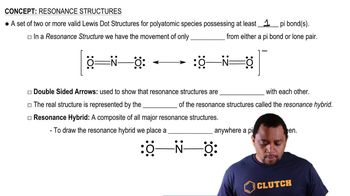
Resonance stabilization occurs when a molecule can be represented by multiple valid Lewis structures, allowing for the delocalization of electrons. In the context of acids, resonance can stabilize the conjugate base formed after the acid donates a proton. The more stable the conjugate base, the stronger the corresponding acid, as it favors the dissociation of protons.
추천 영상:
가이드 코스
01:42
Resonance Structures

Inductive Effect

The inductive effect refers to the electron-withdrawing or electron-donating effects of substituents attached to a molecule. Electron-withdrawing groups can increase acid strength by stabilizing the negative charge on the conjugate base, while electron-donating groups can decrease acid strength. Understanding the inductive effects of substituents on benzoic acid and phenol is crucial for predicting their relative acid strengths.
추천 영상:
가이드 코스
02:31
Photoelectric Effect