
Ch.16 - Acid-Base Equilibria
Brown - Chemistry: The Central Science 14th Edition
Brown14th EditionChemistry: The Central ScienceISBN: 9780134414232당신이 사용하는 게 아니라요?교과서 변경
16장, 문제 114b

The amino acid glycine (H2N–CH2–COOH) can participate in the following equilibria in water:
H2N–CH2–COOH + H2O ⇌ H2N–CH2–COO– + H3O+ Ka = 4.3 × 10⁻³
H2N–CH2–COOH + H2O⇌ +H3N–CH2–COOH + OH- Kb = 6.0 × 10⁻⁵
(b) What is the pH of a 0.050 M aqueous solution of glycine?

검증된 단계별 안내
1
Identify the relevant equilibria for glycine in water: the acid dissociation (Ka) and the base dissociation (Kb).
Recognize that glycine can act as both an acid and a base, making it an amphoteric species. Use the given Ka and Kb values to determine which equilibrium will dominate in a 0.050 M solution.
Calculate the concentration of hydronium ions \([H_3O^+]\) using the acid dissociation constant \(K_a\) and the initial concentration of glycine. Use the expression: \[ K_a = \frac{[H_3O^+][H_2N-CH_2-COO^-]}{[H_2N-CH_2-COOH]} \]
Assume that the change in concentration of glycine due to dissociation is small compared to the initial concentration, allowing simplification of the equilibrium expression.
Calculate the pH from the hydronium ion concentration using the formula: \( \text{pH} = -\log[H_3O^+] \).

비슷한 문제에 대한 검증된 영상 답변:

이 영상 해법은 위 문제에 도움이 된다고 튜터들이 추천한 것입니다.
영상 길이:
7m

주요 개념

질문에 올바르게 답하기 위해 반드시 이해해야 하는 핵심 개념들은 다음과 같습니다.

Acid-Base Equilibria

Acid-base equilibria involve the transfer of protons (H+) between species in solution. In the case of glycine, it can act as both an acid and a base, participating in equilibria that define its behavior in water. Understanding the dissociation constants (Ka and Kb) is crucial for predicting the pH of the solution, as they indicate the strength of the acid and base forms of glycine.
추천 영상:
가이드 코스
02:00
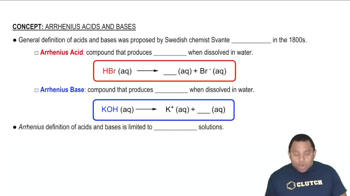
Arrhenius Acids and Bases

Dissociation Constants (Ka and Kb)

Dissociation constants, Ka and Kb, quantify the extent to which an acid or base dissociates in water. Ka represents the equilibrium constant for the dissociation of an acid, while Kb represents the equilibrium constant for the dissociation of a base. For glycine, the given values of Ka and Kb allow us to calculate the concentrations of the various species in solution, which is essential for determining the pH.
추천 영상:
가이드 코스
03:01
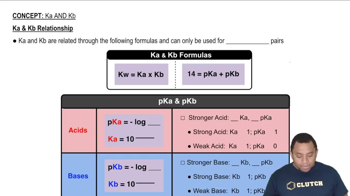
Ka and Kb Relationship

pH Calculation

pH is a measure of the hydrogen ion concentration in a solution, calculated using the formula pH = -log[H+]. In the context of glycine, the pH can be determined by considering the contributions of both the acidic and basic forms of the amino acid in solution. By applying the Henderson-Hasselbalch equation or directly using the dissociation constants, one can find the pH of the glycine solution.
추천 영상:
가이드 코스
02:15
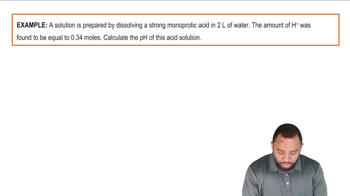
pH Calculation Example