Ch.16 - Acid-Base Equilibria

Brown14th EditionChemistry: The Central ScienceISBN: 9780134414232
당신이 사용하는 게 아니라요?교과서 변경다른 교과서를 선택하세요
TOC.tableOfContents
- Ch.1 - Introduction: Matter, Energy, and Measurement177
- Ch.2 - Atoms, Molecules, and Ions231
- Ch.3 - Chemical Reactions and Reaction Stoichiometry216
- Ch.4 - Reactions in Aqueous Solution189
- Ch.5 - Thermochemistry175
- Ch.6 - Electronic Structure of Atoms168
- Ch.7 - Periodic Properties of the Elements150
- Ch.8 - Basic Concepts of Chemical Bonding177
- Ch.9 - Molecular Geometry and Bonding Theories200
- Ch.10 - Gases179
- Ch.11 - Liquids and Intermolecular Forces113
- Ch.12 - Solids and Modern Materials154
- Ch.13 - Properties of Solutions157
- Ch.14 - Chemical Kinetics199
- Ch.15 - Chemical Equilibrium128
- Ch.16 - Acid-Base Equilibria164
- Ch.17 - Additional Aspects of Aqueous Equilibria163
- Ch.18 - Chemistry of the Environment105
- Ch.19 - Chemical Thermodynamics164
- Ch.20 - Electrochemistry171
- Ch.21 - Nuclear Chemistry122
- Ch.22 - Chemistry of the Nonmetals82
- Ch.23 - Transition Metals and Coordination Chemistry79
- Ch.24 - The Chemistry of Life: Organic and Biological Chemistry16

16장, 문제 126
Using dissociation constants from Appendix D, determine the value for the equilibrium constant for each of the following reactions. (i) HCO3-1aq2 + OH-1aq2 ΔCO32-1aq2 + H2O1l2 (ii) NH4+1aq2 + CO32-1aq2 ΔNH31aq2 + HCO3-1aq2
 검증된 단계별 안내
1
Identify the dissociation reactions and their constants (Ka or Kb) for each species involved in the given reactions. For reaction (i), look up the Ka for HCO3- dissociating to CO3^2- and H+, and the Kb for OH- reacting to form H2O and O2-. For reaction (ii), find the Kb for NH4+ dissociating to NH3 and H+, and the Ka for CO3^2- dissociating to HCO3- and OH-.
Write the equilibrium expressions for each dissociation reaction using the formula Ka = [Products]/[Reactants] for acid dissociation and Kb = [Products]/[Reactants] for base dissociation. Ensure to exclude water (H2O) in the expression as its concentration remains relatively constant.
Combine the expressions from step 2 to form the overall equilibrium constant (K) for the given reactions. For reaction (i), multiply the Ka of HCO3- by the reciprocal of the Kb of OH- (since OH- is a base and its reaction is the reverse of dissociation). For reaction (ii), multiply the Kb of NH4+ by the reciprocal of the Ka of CO3^2-.
Simplify the expressions obtained in step 3 to get the final form of the equilibrium constant for each reaction. This involves canceling out any common species and simplifying the mathematical expression.
Use the values of Ka and Kb from Appendix D to substitute into the simplified expressions from step 4 to calculate the numerical values of the equilibrium constants for reactions (i) and (ii).
비슷한 문제에 대한 검증된 영상 답변:
이 영상 해법은 위 문제에 도움이 된다고 튜터들이 추천한 것입니다.

영상 길이:
3m주요 개념
질문에 올바르게 답하기 위해 반드시 이해해야 하는 핵심 개념들은 다음과 같습니다.
Dissociation Constants
Dissociation constants (K) are equilibrium constants that describe the extent to which a compound dissociates into its ions in solution. For acids and bases, these constants help quantify the strength of the acid or base. The larger the dissociation constant, the stronger the acid or base, indicating a greater tendency to donate or accept protons.
추천 영상:
가이드 코스
 01:14
01:14
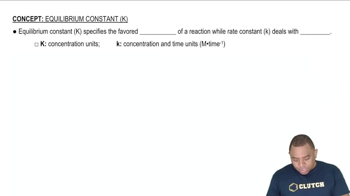
Equilibrium Constant K
Equilibrium Constant (K_eq)
The equilibrium constant (K_eq) is a numerical value that expresses the ratio of the concentrations of products to reactants at equilibrium for a given reaction. It is calculated using the formula K_eq = [products]/[reactants], where the concentrations are raised to the power of their coefficients in the balanced equation. Understanding K_eq is essential for predicting the direction of a reaction and its extent.
추천 영상:
가이드 코스
01:14Equilibrium Constant K
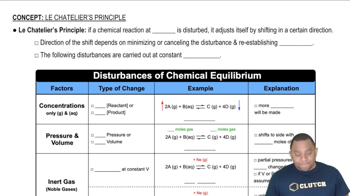
Le Chatelier's Principle
Le Chatelier's Principle states that if a dynamic equilibrium is disturbed by changing the conditions, the system will adjust to counteract the change and restore a new equilibrium. This principle is crucial in understanding how changes in concentration, temperature, or pressure affect the position of equilibrium in chemical reactions, including those involving acids and bases.
추천 영상:
가이드 코스
 07:32
07:32Le Chatelier's Principle
관련 실천