
Ch.16 - Acid-Base Equilibria
Brown - Chemistry: The Central Science 14th Edition
Brown14th EditionChemistry: The Central ScienceISBN: 9780134414232당신이 사용하는 게 아니라요?교과서 변경
16장, 문제 24

Which of the following is the stronger Brønsted–Lowry acid, HClO3 or HClO2?

검증된 단계별 안내
1
Identify the Brønsted–Lowry acid: A Brønsted–Lowry acid is a substance that donates a proton (H⁺) in a chemical reaction.
Compare the structures: HClO₃ (chloric acid) and HClO₂ (chlorous acid) differ in the number of oxygen atoms bonded to the central chlorine atom.
Consider the effect of oxygen atoms: More oxygen atoms increase the acid strength due to the inductive effect, which stabilizes the conjugate base by delocalizing the negative charge.
Analyze the inductive effect: HClO₃ has more oxygen atoms than HClO₂, which means it has a stronger inductive effect, leading to a more stable conjugate base.
Conclude the comparison: Based on the number of oxygen atoms and the inductive effect, HClO₃ is the stronger Brønsted–Lowry acid compared to HClO₂.

주요 개념

질문에 올바르게 답하기 위해 반드시 이해해야 하는 핵심 개념들은 다음과 같습니다.

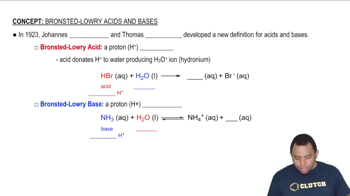
Brønsted–Lowry Acid-Base Theory

The Brønsted–Lowry theory defines acids as proton donors and bases as proton acceptors. This framework allows for the classification of substances based on their ability to donate or accept hydrogen ions (H+). Understanding this theory is essential for comparing the strength of acids, as stronger acids are more effective at donating protons.
추천 영상:
가이드 코스
02:08
Bronsted-Lowry Acid-Base Theory

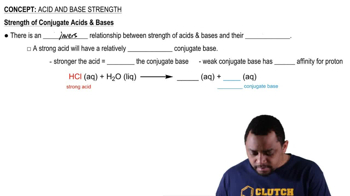
Acid Strength and Conjugate Bases

The strength of an acid is often determined by its ability to dissociate in solution and the stability of its conjugate base. A stronger acid will have a weaker conjugate base, which is less likely to re-accept the proton. In the case of HClO3 and HClO2, analyzing the stability of their respective conjugate bases (ClO3- and ClO2-) is crucial for determining which acid is stronger.
추천 영상:
가이드 코스
00:50
Strength of Conjugate Acids and Bases

Oxidation State and Acid Strength

In oxyacids, the oxidation state of the central atom can influence acid strength. Generally, as the oxidation state of the central atom increases, the acid strength also increases due to the greater positive charge, which stabilizes the conjugate base after proton donation. This concept is particularly relevant when comparing HClO3 (where Cl is in a higher oxidation state) to HClO2.
추천 영상:
가이드 코스
03:51
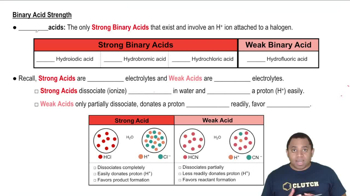
Binary Acid Strengths