
Ch.17 - Additional Aspects of Aqueous Equilibria
Brown - Chemistry: The Central Science 14th Edition
Brown14th EditionChemistry: The Central ScienceISBN: 9780134414232당신이 사용하는 게 아니라요?교과서 변경
17장, 문제 89

A biochemist needs 750 mL of an acetic acid–sodium acetate buffer with pH 4.50. Solid sodium acetate (CH3COONa) and glacial acetic acid (CH3COOH) are available. Glacial acetic acid is 99% CH3COOH by mass and has a density of 1.05 g/mL. If the buffer is to be 0.15 M in CH3COOH, how many grams of CH3COONa and how many milliliters of glacial acetic acid must be used?

검증된 단계별 안내
1
Calculate the moles of CH3COOH needed using the formula: moles = molarity \(\times\) volume. Use the given molarity (0.15 M) and convert the volume from mL to L (750 mL = 0.750 L).
Determine the mass of CH3COOH required using the moles calculated and the molar mass of CH3COOH (60.05 g/mol).
Calculate the volume of glacial acetic acid needed using the mass of CH3COOH and the density of glacial acetic acid (1.05 g/mL). Remember that glacial acetic acid is 99% CH3COOH by mass.
Use the Henderson-Hasselbalch equation to find the ratio of [CH3COONa] to [CH3COOH] needed for the buffer: pH = pKa + log([CH3COONa]/[CH3COOH]). Use the given pH (4.50) and the pKa of acetic acid (4.76).
Calculate the moles of CH3COONa needed using the ratio from the Henderson-Hasselbalch equation and the moles of CH3COOH. Then, convert the moles of CH3COONa to grams using its molar mass (82.03 g/mol).

주요 개념

질문에 올바르게 답하기 위해 반드시 이해해야 하는 핵심 개념들은 다음과 같습니다.

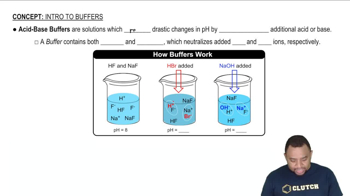
Buffer Solutions

Buffer solutions are mixtures that resist changes in pH when small amounts of acid or base are added. They typically consist of a weak acid and its conjugate base, which in this case are acetic acid (CH3COOH) and sodium acetate (CH3COONa). Understanding how buffers work is essential for maintaining the desired pH in biochemical reactions.
추천 영상:
가이드 코스
03:02
Buffer Solutions

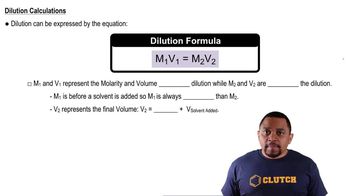
Molarity and Dilution

Molarity (M) is a measure of concentration defined as the number of moles of solute per liter of solution. In this problem, the biochemist requires a specific molarity of acetic acid in the buffer solution. Calculating the required volume of glacial acetic acid involves using its density and the molarity formula to ensure the correct concentration is achieved.
추천 영상:
가이드 코스
00:58
Dilution Equation

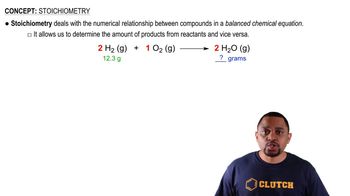
Stoichiometry

Stoichiometry involves the calculation of reactants and products in chemical reactions based on balanced equations. In this context, it is used to determine the amounts of sodium acetate and acetic acid needed to create the buffer solution at the specified pH and concentration. Understanding stoichiometric relationships is crucial for accurate preparation of chemical solutions.
추천 영상:
가이드 코스
01:16
Stoichiometry Concept