Ch.17 - Additional Aspects of Aqueous Equilibria
Brown - Chemistry: The Central Science 14th Edition
Brown14th EditionChemistry: The Central ScienceISBN: 9780134414232당신이 사용하는 게 아니라요?교과서 변경
17장, 문제 21a

(a) Calculate the pH of a buffer that is 0.12 M in lactic acid and 0.11 M in sodium lactate.

검증된 단계별 안내
1
Identify the acid and its conjugate base in the buffer system. Here, lactic acid (HC3H5O3) is the weak acid and sodium lactate (NaC3H5O3) is the salt of its conjugate base (C3H5O3-).
Write the acid dissociation reaction for lactic acid: HC3H5O3(aq) ⇌ H+(aq) + C3H5O3-(aq).
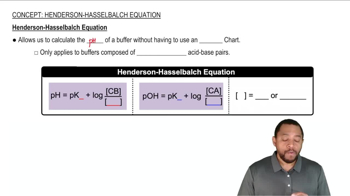
Use the Henderson-Hasselbalch equation to calculate the pH of the buffer: pH = pKa + \(\log\)\(\left\)(\(\frac{[\text{Conjugate Base}\)]}{[\(\text{Acid}\)]}\(\right\)).
Find the pKa value of lactic acid from a reliable source, such as a chemistry textbook or database.
Substitute the concentrations of the acid ([HC3H5O3] = 0.12 M) and the conjugate base ([C3H5O3-] = 0.11 M), along with the pKa value, into the Henderson-Hasselbalch equation to solve for pH.

비슷한 문제에 대한 검증된 영상 답변:

이 영상 해법은 위 문제에 도움이 된다고 튜터들이 추천한 것입니다.
영상 길이:
4m

주요 개념

질문에 올바르게 답하기 위해 반드시 이해해야 하는 핵심 개념들은 다음과 같습니다.

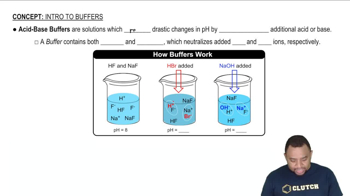
Buffer Solutions

Buffer solutions are mixtures that resist changes in pH when small amounts of acid or base are added. They typically consist of a weak acid and its conjugate base, or a weak base and its conjugate acid. In this case, lactic acid (weak acid) and sodium lactate (conjugate base) form a buffer system that helps maintain a stable pH.
추천 영상:
가이드 코스
03:02
Buffer Solutions

Henderson-Hasselbalch Equation

The Henderson-Hasselbalch equation is a mathematical formula used to calculate the pH of a buffer solution. It is expressed as pH = pKa + log([A-]/[HA]), where pKa is the negative logarithm of the acid dissociation constant, [A-] is the concentration of the conjugate base, and [HA] is the concentration of the weak acid. This equation is essential for determining the pH of the given buffer solution.
추천 영상:
가이드 코스
02:40
Henderson-Hasselbalch Equation

pKa and Acid-Base Equilibrium

pKa is a measure of the strength of an acid in solution, representing the pH at which half of the acid is dissociated. It is crucial for understanding acid-base equilibria, as it helps predict how a buffer will respond to changes in pH. For lactic acid, knowing its pKa allows for accurate calculations of the buffer's pH using the Henderson-Hasselbalch equation.
추천 영상:
가이드 코스
04:30
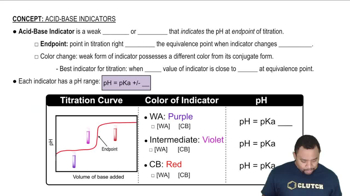
Acid-Base Indicators