Ch.17 - Additional Aspects of Aqueous Equilibria
Brown - Chemistry: The Central Science 14th Edition
Brown14th EditionChemistry: The Central ScienceISBN: 9780134414232당신이 사용하는 게 아니라요?교과서 변경
17장, 문제 52a

(a) True or false: 'solubility' and 'solubility-product constant' are the same number for a given compound.

검증된 단계별 안내
1
Understand the definition of 'solubility': Solubility refers to the maximum amount of a solute that can dissolve in a given amount of solvent at a specific temperature, usually expressed in grams per liter (g/L) or moles per liter (M).
Understand the definition of 'solubility-product constant' (Ksp): The solubility-product constant is an equilibrium constant that applies to the dissolution of a sparingly soluble ionic compound. It is expressed in terms of the concentrations of the ions produced, raised to the power of their stoichiometric coefficients in the dissolution equation.
Recognize the difference in units: Solubility is typically expressed in units of concentration (g/L or M), while the solubility-product constant is unitless, as it is a product of the concentrations of the ions, each raised to the power of their coefficients in the balanced chemical equation.
Consider the relationship between solubility and Ksp: While both solubility and Ksp describe aspects of a compound's ability to dissolve, they are not the same numerical value. Solubility is a direct measure of how much of a compound can dissolve, whereas Ksp describes the extent to which a compound can dissolve into its constituent ions at equilibrium.
Conclude the truth value: Given the differences in definition, units, and what they measure, 'solubility' and 'solubility-product constant' are not the same number for a given compound, making the statement false.

비슷한 문제에 대한 검증된 영상 답변:

이 영상 해법은 위 문제에 도움이 된다고 튜터들이 추천한 것입니다.
영상 길이:
2m
도움이 되었나요?

주요 개념

질문에 올바르게 답하기 위해 반드시 이해해야 하는 핵심 개념들은 다음과 같습니다.

Solubility

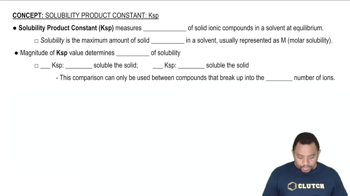
Solubility refers to the maximum amount of a solute that can dissolve in a solvent at a given temperature and pressure. It is typically expressed in terms of concentration, such as moles per liter (M). Solubility can vary with temperature and the nature of the solute and solvent, making it a crucial factor in understanding how substances interact in solution.
추천 영상:
가이드 코스
00:28
Solubility Rules

Solubility-Product Constant (Ksp)

The solubility-product constant (Ksp) is an equilibrium constant that applies to the solubility of sparingly soluble ionic compounds. It is defined as the product of the molar concentrations of the ions, each raised to the power of their coefficients in the balanced dissolution equation. Ksp provides a quantitative measure of a compound's solubility and is temperature-dependent.
추천 영상:
가이드 코스
01:47
Solubility Product Constant

Relationship Between Solubility and Ksp

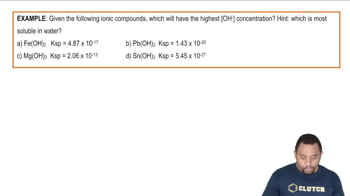
While solubility and Ksp are related, they are not the same. Solubility is a measure of how much of a compound can dissolve, while Ksp is a constant that reflects the equilibrium condition of the dissolved ions. For a given compound, the solubility can be calculated from Ksp, but the two values differ, especially for compounds that dissociate into multiple ions.
추천 영상:
가이드 코스
01:12
Ksp and Solubility Example