
You are asked to prepare a pH = 3.00 buffer solution starting from 1.25 L of a 1.00 M solution of hydrofluoric acid (HF) and any amount you need of sodium fluoride (NaF). (a) What is the pH of the hydrofluoric acid solution prior to adding sodium fluoride?
Ch.17 - Additional Aspects of Aqueous Equilibria
17장, 문제 25b
You are asked to prepare a pH = 3.00 buffer solution starting from 1.25 L of a 1.00 M solution of hydrofluoric acid (HF) and any amount you need of sodium fluoride (NaF). (b) How many grams of sodium fluoride should be added to prepare the buffer solution? Neglect the small volume change that occurs when the sodium fluoride is added.
검증된 단계별 안내1
Calculate the initial moles of HF in the solution by multiplying the concentration of HF by the volume of the solution in liters.
Use the Henderson-Hasselbalch equation for buffer solutions, pH = pKa + log([A-]/[HA]), where [A-] is the concentration of the fluoride ion (F-) and [HA] is the concentration of hydrofluoric acid (HF). The pKa of HF is approximately 3.17.
Rearrange the Henderson-Hasselbalch equation to solve for the ratio [F-]/[HF] needed to achieve the desired pH of 3.00.
Calculate the moles of F- needed based on the moles of HF initially present and the ratio [F-]/[HF] obtained from the Henderson-Hasselbalch equation.
Convert the moles of F- to grams of sodium fluoride (NaF) by using the molar mass of NaF (approximately 42 g/mol).

비슷한 문제에 대한 검증된 영상 답변:
이 영상 해법은 위 문제에 도움이 된다고 튜터들이 추천한 것입니다.
영상 길이:
10m주요 개념
질문에 올바르게 답하기 위해 반드시 이해해야 하는 핵심 개념들은 다음과 같습니다.
Buffer Solutions
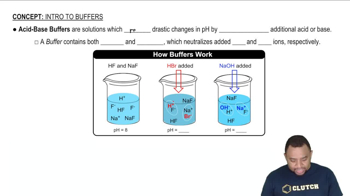
A buffer solution is a system that resists changes in pH upon the addition of small amounts of acid or base. It typically consists of a weak acid and its conjugate base, or a weak base and its conjugate acid. In this case, hydrofluoric acid (HF) acts as the weak acid, while sodium fluoride (NaF) provides the conjugate base, fluoride ion (F-), necessary to maintain the desired pH.
추천 영상:
가이드 코스
Buffer Solutions
Henderson-Hasselbalch Equation
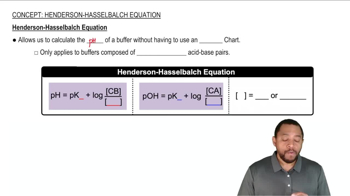
The Henderson-Hasselbalch equation is a mathematical formula used to calculate the pH of a buffer solution. It is expressed as pH = pKa + log([A-]/[HA]), where [A-] is the concentration of the conjugate base and [HA] is the concentration of the weak acid. For this problem, knowing the pKa of HF allows us to determine the required ratio of NaF to HF to achieve the target pH of 3.00.
추천 영상:
가이드 코스
Henderson-Hasselbalch Equation
Molar Mass and Mass Calculations
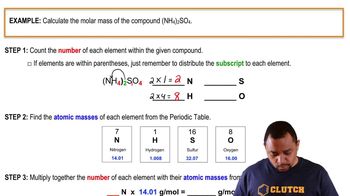
To determine how many grams of sodium fluoride (NaF) are needed, one must first calculate the number of moles required using the desired concentration and volume of the buffer solution. The molar mass of NaF is then used to convert moles into grams. This step is crucial for accurately preparing the buffer solution with the correct proportions of its components.
추천 영상:
가이드 코스
Molar Mass Calculation Example
관련 실천
교과서 질문
311
views
교과서 질문
You are asked to prepare a pH = 4.00 buffer starting from 1.50 L of 0.0200 M solution of benzoic acid 1C6H5COOH2 and any amount you need of sodium benzoate 1C6H5COONa2. (b) How many grams of sodium benzoate should be added to prepare the buffer? Neglect the small volume change that occurs when the sodium benzoate is added.
1095
views
교과서 질문
A buffer contains 0.10 mol of acetic acid and 0.13 mol of sodium acetate in 1.00 L. (a) What is the pH of this buffer?
678
views
교과서 질문
You are asked to prepare a pH = 4.00 buffer starting from 1.50 L of 0.0200 M solution of benzoic acid 1C6H5COOH2 and any amount you need of sodium benzoate 1C6H5COONa2. (a) What is the pH of the benzoic acid solution prior to adding sodium benzoate?
327
views
