Ch.18 - Chemistry of the Environment
Brown - Chemistry: The Central Science 14th Edition
Brown14th EditionChemistry: The Central ScienceISBN: 9780134414232당신이 사용하는 게 아니라요?교과서 변경
18장, 문제 33d

Alcohol-based fuels for automobiles lead to the production of formaldehyde (CH2O) in exhaust gases. Formaldehyde undergoes photodissociation, which contributes to photo- chemical smog: CH2O + hn ¡ CHO + H The maximum wavelength of light that can cause this reac- tion is 335 nm. (d) Write out the formaldehyde photodis- sociation reaction, showing Lewis-dot structures.

검증된 단계별 안내
1
Identify the reactants and products in the photodissociation reaction: CH2O (formaldehyde) breaks down into CHO and H.
Draw the Lewis-dot structure for formaldehyde (CH2O): Carbon (C) is the central atom, double-bonded to oxygen (O) and single-bonded to two hydrogen (H) atoms.
Draw the Lewis-dot structure for the formyl radical (CHO): Carbon (C) is double-bonded to oxygen (O) and single-bonded to hydrogen (H), with an unpaired electron on carbon.
Draw the Lewis-dot structure for the hydrogen atom (H): A single hydrogen atom with one valence electron.
Combine the structures to represent the photodissociation reaction: CH2O (with its Lewis structure) + h\(\nu\) \(\rightarrow\) CHO (with its Lewis structure) + H (with its Lewis structure).

비슷한 문제에 대한 검증된 영상 답변:

이 영상 해법은 위 문제에 도움이 된다고 튜터들이 추천한 것입니다.
영상 길이:
5m

주요 개념

질문에 올바르게 답하기 위해 반드시 이해해야 하는 핵심 개념들은 다음과 같습니다.

Photodissociation

Photodissociation is a process in which a chemical compound breaks down into smaller components due to the absorption of light energy. In the case of formaldehyde (CH2O), it absorbs photons of a specific wavelength, leading to the formation of carbon monoxide (CHO) and a hydrogen atom. This reaction is significant in atmospheric chemistry, as it contributes to the formation of pollutants like photochemical smog.

Lewis Dot Structures

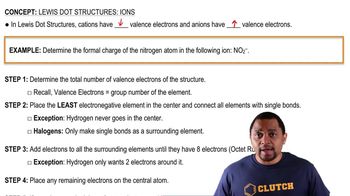
Lewis dot structures are diagrams that represent the valence electrons of atoms within a molecule. They illustrate how electrons are shared or transferred between atoms, helping to visualize molecular bonding and structure. For formaldehyde, the Lewis structure shows the central carbon atom bonded to two hydrogen atoms and one oxygen atom, with appropriate electron pairs depicted to indicate bonding and lone pairs.
추천 영상:
가이드 코스
04:28
Lewis Dot Structures: Ions

Wavelength and Energy of Light

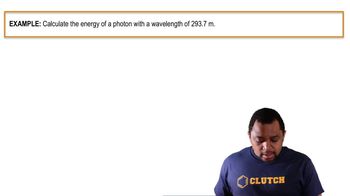
The wavelength of light is inversely related to its energy, as described by the equation E = hc/λ, where E is energy, h is Planck's constant, c is the speed of light, and λ is the wavelength. In the context of photodissociation, the maximum wavelength of 335 nm indicates the threshold at which formaldehyde can absorb light energy sufficient to break its chemical bonds. Understanding this relationship is crucial for predicting the behavior of molecules under light exposure.
추천 영상:
가이드 코스
01:08
Photon Energy Example