

Ch.18 - Chemistry of the Environment
Brown - Chemistry: The Central Science 14th Edition
Brown14th EditionChemistry: The Central ScienceISBN: 9780134414232당신이 사용하는 게 아니라요?교과서 변경
18장, 문제 34b

An important reaction in the formation of photochemical smog is the photodissociation of NO : NO2 + hv → NO(g) + O(g) The maximum wavelength of light that can cause this reaction is 420 nm. (b) What is the maximum strength of a bond, in kJ/mol, that can be broken by absorption of a photon of 420-nm light?

검증된 단계별 안내
1
First, understand that the energy of a photon is related to its wavelength by the equation: E = \(\frac{hc}{\lambda}\), where E is the energy, h is Planck's constant (6.626 \(\times\) 10^{-34} \(\text{J s}\)), c is the speed of light (3.00 \(\times\) 10^{8} \(\text{m/s}\)), and \(\lambda\) is the wavelength in meters.
Convert the given wavelength from nanometers to meters. Since 1 nm = 10^{-9} m, the wavelength \(\lambda\) = 420 \(\text{ nm}\) = 420 \(\times\) 10^{-9} \(\text{ m}\).
Substitute the values of h, c, and \(\lambda\) into the equation E = \(\frac{hc}{\lambda}\) to calculate the energy of a single photon in joules.
Convert the energy from joules per photon to kilojoules per mole. Use Avogadro's number (6.022 \(\times\) 10^{23} \(\text{mol}\)^{-1}) to find the energy per mole: E_{\(\text{kJ/mol}\)} = E_{\(\text{J/photon}\)} \(\times\) \(\frac{1 \text{ kJ}\)}{1000 \(\text{ J}\)} \(\times\) 6.022 \(\times\) 10^{23} \(\text{mol}\)^{-1}.
The calculated energy in kJ/mol represents the maximum bond strength that can be broken by absorption of a photon of 420-nm light.

비슷한 문제에 대한 검증된 영상 답변:

이 영상 해법은 위 문제에 도움이 된다고 튜터들이 추천한 것입니다.
영상 길이:
6m

주요 개념

질문에 올바르게 답하기 위해 반드시 이해해야 하는 핵심 개념들은 다음과 같습니다.

Photodissociation

Photodissociation is a process in which a chemical bond is broken due to the absorption of light, resulting in the formation of two or more products. In the context of the given reaction, the absorption of a photon by nitrogen dioxide (NO2) leads to the formation of nitric oxide (NO) and an oxygen atom (O). Understanding this concept is crucial for analyzing how light energy can influence chemical reactions and bond strengths.

Photon Energy and Wavelength

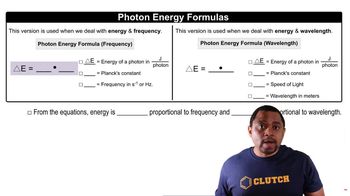
The energy of a photon is inversely related to its wavelength, described by the equation E = hc/λ, where E is energy, h is Planck's constant, c is the speed of light, and λ is the wavelength. For a photon with a wavelength of 420 nm, calculating its energy allows us to determine the maximum bond strength that can be overcome by this energy. This relationship is fundamental in photochemistry and helps in understanding how light interacts with matter.
추천 영상:
가이드 코스
01:40
Photon Energy Formulas

Bond Strength

Bond strength refers to the amount of energy required to break a bond between two atoms in a molecule, typically measured in kJ/mol. The bond strength is directly related to the stability of the molecule; stronger bonds require more energy to break. In the context of the question, determining the maximum bond strength that can be broken by a photon of 420 nm light involves understanding how the energy of the photon compares to the energy required to break specific chemical bonds.
추천 영상:
가이드 코스
00:36
Average Bond Order
관련 실천