Ch.18 - Chemistry of the Environment
Brown - Chemistry: The Central Science 14th Edition
Brown14th EditionChemistry: The Central ScienceISBN: 9780134414232당신이 사용하는 게 아니라요?교과서 변경
18장, 문제 28b

(b) Based on average bond enthalpies, would you expect a photon capable of dissociating a C-Cl bond to have sufficient energy to dissociate a C-Br bond?

검증된 단계별 안내
1
Step 1: Understand the concept of bond enthalpy. Bond enthalpy is the energy required to break a bond between two atoms. The higher the bond enthalpy, the stronger the bond and the more energy is required to break it.
Step 2: Look up the average bond enthalpies for C-Cl and C-Br. The bond enthalpy for C-Cl is typically higher than that for C-Br.
Step 3: Understand the concept of photon energy. The energy of a photon is directly proportional to its frequency and inversely proportional to its wavelength. Therefore, a photon with higher energy has a higher frequency and a shorter wavelength.
Step 4: Apply the concepts. If a photon has enough energy to break a C-Cl bond (which has a higher bond enthalpy), it should also have enough energy to break a C-Br bond (which has a lower bond enthalpy).
Step 5: Conclude. Therefore, a photon capable of dissociating a C-Cl bond would have sufficient energy to dissociate a C-Br bond.

비슷한 문제에 대한 검증된 영상 답변:

이 영상 해법은 위 문제에 도움이 된다고 튜터들이 추천한 것입니다.
영상 길이:
1m

주요 개념

질문에 올바르게 답하기 위해 반드시 이해해야 하는 핵심 개념들은 다음과 같습니다.

Bond Enthalpy

Bond enthalpy, or bond dissociation energy, is the amount of energy required to break a specific bond in a molecule in the gas phase. It is a measure of bond strength; stronger bonds have higher bond enthalpies. Understanding bond enthalpy is crucial for predicting whether a photon can provide enough energy to break a particular bond, such as C-Cl or C-Br.
추천 영상:
가이드 코스
02:34
Enthalpy of Formation

Photon Energy

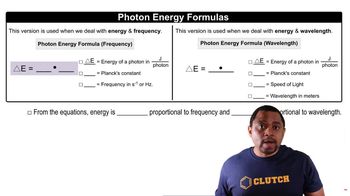
A photon is a quantum of electromagnetic radiation, and its energy is directly proportional to its frequency, as described by the equation E = hν, where E is energy, h is Planck's constant, and ν is frequency. To determine if a photon can dissociate a bond, one must compare the energy of the photon to the bond enthalpy of the bond in question. If the photon's energy is greater than or equal to the bond enthalpy, bond dissociation can occur.
추천 영상:
가이드 코스
01:40
Photon Energy Formulas

Comparative Bond Strengths

Comparative bond strengths refer to the differences in bond enthalpies between similar bonds, such as C-Cl and C-Br. Generally, C-Cl bonds are stronger than C-Br bonds due to the smaller size and greater electronegativity of chlorine compared to bromine. This concept is essential for predicting whether a photon that can dissociate a C-Cl bond can also dissociate a C-Br bond, as it involves understanding the relative energies required for breaking these bonds.
추천 영상:
가이드 코스
01:58
Comparing Binary Acid Strength