Ch.18 - Chemistry of the Environment
Brown - Chemistry: The Central Science 14th Edition
Brown14th EditionChemistry: The Central ScienceISBN: 9780134414232당신이 사용하는 게 아니라요?교과서 변경
18장, 문제 65

What properties of CFCs make them ideal for various commercial applications but also make them a long-term problem in the stratosphere?

검증된 단계별 안내
1
Step 1: Understand the chemical structure of CFCs (Chlorofluorocarbons). They are composed of carbon, chlorine, and fluorine atoms, which makes them stable and non-flammable.
Step 2: Identify the properties that make CFCs ideal for commercial applications. Their stability, low toxicity, and non-reactivity make them suitable for use as refrigerants, propellants in aerosol applications, and solvents.
Step 3: Explore why the stability of CFCs is a double-edged sword. While their stability is beneficial for commercial use, it also means they do not break down easily in the lower atmosphere.
Step 4: Explain how CFCs reach the stratosphere. Due to their stability, CFCs can persist in the atmosphere for a long time and eventually drift up to the stratosphere.
Step 5: Discuss the environmental impact of CFCs in the stratosphere. Once in the stratosphere, CFCs are broken down by ultraviolet (UV) radiation, releasing chlorine atoms that catalyze the destruction of ozone molecules, leading to ozone layer depletion.

주요 개념

질문에 올바르게 답하기 위해 반드시 이해해야 하는 핵심 개념들은 다음과 같습니다.

Chemical Properties of CFCs

Chlorofluorocarbons (CFCs) are stable, non-toxic, and non-flammable compounds that have low boiling points, making them ideal for use as refrigerants, propellants, and solvents. Their chemical stability allows them to remain in the atmosphere for extended periods, which is beneficial for commercial applications but problematic for environmental impact.
추천 영상:
가이드 코스
03:31
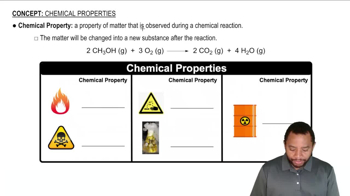
Chemical Properties

Ozone Layer Depletion

CFCs contribute to ozone layer depletion when they are released into the atmosphere. Once in the stratosphere, UV radiation breaks down CFCs, releasing chlorine atoms that catalyze the destruction of ozone molecules, leading to increased UV radiation reaching the Earth's surface, which can cause health and environmental issues.
추천 영상:
가이드 코스
08:52
Acid-Base Extraction

Global Warming Potential (GWP)

CFCs have a high Global Warming Potential, meaning they can trap heat in the atmosphere much more effectively than carbon dioxide. This property, combined with their long atmospheric lifetime, makes CFCs significant contributors to climate change, posing a long-term environmental challenge despite their utility in various applications.
추천 영상:
가이드 코스
00:34
Kinetic & Potential Energy