Ch.19 - Chemical Thermodynamics
Brown - Chemistry: The Central Science 14th Edition
Brown14th EditionChemistry: The Central ScienceISBN: 9780134414232당신이 사용하는 게 아니라요?교과서 변경
19장, 문제 34a

(a) In a chemical reaction, two gases combine to form a solid. What do you expect for the sign of ΔS?

검증된 단계별 안내
1
Identify the phase changes in the reaction. In this case, two gases combine to form a solid.
Recall that entropy (ΔS) is a measure of the randomness or disorder of a system. Gases have higher entropy compared to solids because gas particles are more spread out and move more freely.
Understand that when gases transform into a solid, the system becomes more ordered. This decrease in randomness leads to a decrease in entropy.
Conclude that the sign of ΔS for this reaction, where gases form a solid, would be negative because the entropy of the system decreases.
Summarize that the expected sign of ΔS for the reaction is negative, indicating a decrease in entropy as the system changes from a more disordered state (gases) to a more ordered state (solid).

비슷한 문제에 대한 검증된 영상 답변:

이 영상 해법은 위 문제에 도움이 된다고 튜터들이 추천한 것입니다.
영상 길이:
51s

주요 개념

질문에 올바르게 답하기 위해 반드시 이해해야 하는 핵심 개념들은 다음과 같습니다.

Entropy (ΔS)

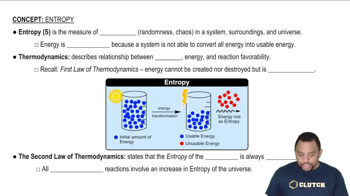
Entropy, denoted as ΔS, is a measure of the disorder or randomness in a system. In chemical reactions, changes in entropy can indicate whether the products are more or less disordered than the reactants. A positive ΔS indicates an increase in disorder, while a negative ΔS indicates a decrease.
추천 영상:
가이드 코스
02:46
Entropy in Thermodynamics

Phase Changes and Entropy

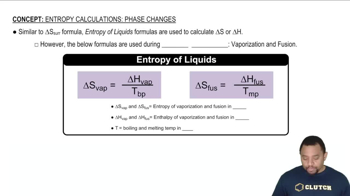
The phase of a substance significantly affects its entropy. Gases have higher entropy due to their greater freedom of movement and disorder compared to solids. When gases react to form a solid, the overall disorder of the system decreases, leading to a negative change in entropy (ΔS < 0).
추천 영상:
가이드 코스
01:46
Entropy in Phase Changes

Gibbs Free Energy and Spontaneity

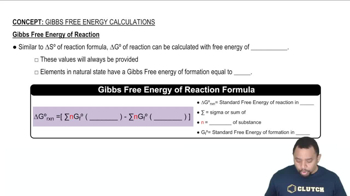
Gibbs Free Energy (ΔG) combines enthalpy and entropy to determine the spontaneity of a reaction. A reaction is spontaneous if ΔG is negative, which can occur even if ΔS is negative, provided that the enthalpy change (ΔH) is sufficiently negative. Understanding the relationship between ΔS and ΔG is crucial for predicting reaction behavior.
추천 영상:
가이드 코스
01:51
Gibbs Free Energy of Reactions