Ch.19 - Chemical Thermodynamics
Brown - Chemistry: The Central Science 14th Edition
Brown14th EditionChemistry: The Central ScienceISBN: 9780134414232당신이 사용하는 게 아니라요?교과서 변경
19장, 문제 72

(a) Using data in Appendix C, estimate the temperature at which the free-energy change for the transformation from I2(s) to I2(g) is zero. (b) Use a reference source, such as Web Elements (www.webelements.com), to find the experimental melting and boiling points of I2. (c) Which of the values in part (b) is closer to the value you obtained in part (a)?

검증된 단계별 안내
1
1. The free-energy change (ΔG) for a transformation is given by the equation ΔG = ΔH - TΔS, where ΔH is the enthalpy change, T is the temperature in Kelvin, and ΔS is the entropy change. For the transformation from I2(s) to I2(g), we want to find the temperature at which ΔG = 0. This occurs when ΔH = TΔS.
2. Look up the values of ΔH and ΔS for the transformation from I2(s) to I2(g) in Appendix C or a similar reference. These values are typically given in kJ/mol for ΔH and J/(mol·K) for ΔS. Note that you may need to convert the units of ΔH to J/mol to match the units of ΔS.
3. Rearrange the equation from step 1 to solve for T: T = ΔH / ΔS. Substitute the values you found in step 2 into this equation to find the temperature at which the free-energy change for the transformation is zero.
4. For part (b), use a reference source such as Web Elements to find the experimental melting and boiling points of I2. These values are typically given in degrees Celsius, so you may need to convert them to Kelvin by adding 273.15.
5. For part (c), compare the temperature you calculated in step 3 with the melting and boiling points you found in step 4. The value that is closer to the temperature you calculated is the phase transition that occurs at approximately the same temperature as the free-energy change becoming zero.

비슷한 문제에 대한 검증된 영상 답변:

이 영상 해법은 위 문제에 도움이 된다고 튜터들이 추천한 것입니다.
영상 길이:
5m
도움이 되었나요?

주요 개념

질문에 올바르게 답하기 위해 반드시 이해해야 하는 핵심 개념들은 다음과 같습니다.

Gibbs Free Energy

Gibbs free energy (G) is a thermodynamic potential that measures the maximum reversible work obtainable from a thermodynamic system at constant temperature and pressure. The change in Gibbs free energy (ΔG) during a process indicates whether it is spontaneous; a ΔG of zero signifies equilibrium. Understanding how to calculate ΔG is essential for determining the temperature at which phase changes occur, such as the transition from solid to gas.
추천 영상:
가이드 코스
01:51
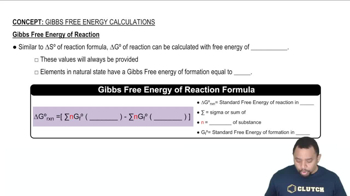
Gibbs Free Energy of Reactions

Phase Transition

A phase transition is the transformation of a substance from one state of matter to another, such as from solid to gas. During this process, energy is absorbed or released, affecting the temperature and pressure conditions. The melting point and boiling point are critical temperatures at which these transitions occur, and they are influenced by the substance's intermolecular forces and environmental conditions.
추천 영상:
가이드 코스
03:22
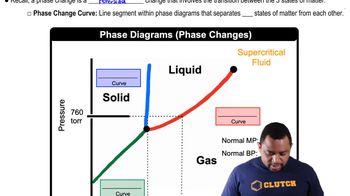
Phase Changes in Diagrams

Melting and Boiling Points

The melting point is the temperature at which a solid becomes a liquid, while the boiling point is the temperature at which a liquid becomes a gas. These points are specific to each substance and are determined by the balance of kinetic energy and intermolecular forces. Comparing the calculated temperature from part (a) with the experimental values from part (b) helps assess the accuracy of the theoretical estimation and the behavior of iodine under different conditions.
추천 영상:
가이드 코스
04:29
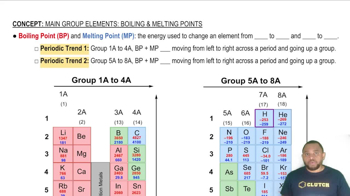
Boiling Point and Melting Point