
Ch.19 - Chemical Thermodynamics
Brown - Chemistry: The Central Science 14th Edition
Brown14th EditionChemistry: The Central ScienceISBN: 9780134414232당신이 사용하는 게 아니라요?교과서 변경
19장, 문제 97c

(c) In each case, indicate whether K should increase or decrease with increasing temperature. (i) 2 Mg(s) + O2 (g) ⇌ 2 MgO(s) (ii) 2 KI(s) ⇌ 2 K(g) + I2(g) (iii) Na2(g) ⇌ 2 Na(g) (iv) 2 V2O5(s) ⇌ 4 V(s) + 5 O2(g)

검증된 단계별 안내
1
Identify the type of reaction for each case: exothermic or endothermic. This can often be inferred from the reaction equation or given data.
Apply Le Chatelier's Principle: For an exothermic reaction, increasing temperature shifts the equilibrium to the left, decreasing K. For an endothermic reaction, increasing temperature shifts the equilibrium to the right, increasing K.
For reaction (i) 2 Mg(s) + O2(g) ⇌ 2 MgO(s), determine if the formation of MgO is exothermic or endothermic. Typically, the formation of metal oxides is exothermic.
For reaction (ii) 2 KI(s) ⇌ 2 K(g) + I2(g), consider the phase change from solid to gas, which usually requires energy input, indicating an endothermic process.
For reactions (iii) Na2(g) ⇌ 2 Na(g) and (iv) 2 V2O5(s) ⇌ 4 V(s) + 5 O2(g), analyze the stoichiometry and phase changes to determine the enthalpy change, and apply Le Chatelier's Principle accordingly.

비슷한 문제에 대한 검증된 영상 답변:

이 영상 해법은 위 문제에 도움이 된다고 튜터들이 추천한 것입니다.
영상 길이:
3m
도움이 되었나요?

주요 개념

질문에 올바르게 답하기 위해 반드시 이해해야 하는 핵심 개념들은 다음과 같습니다.

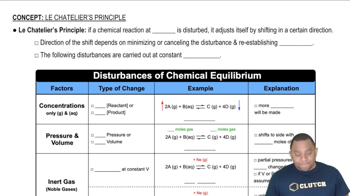
Le Chatelier's Principle

Le Chatelier's Principle states that if a dynamic equilibrium is disturbed by changing the conditions, the position of equilibrium shifts to counteract the change. This principle helps predict how the equilibrium constant (K) will respond to changes in temperature, pressure, or concentration. For example, if a reaction is exothermic, increasing the temperature will shift the equilibrium to favor the reactants, thus decreasing K.
추천 영상:
가이드 코스
07:32
Le Chatelier's Principle

Endothermic and Exothermic Reactions

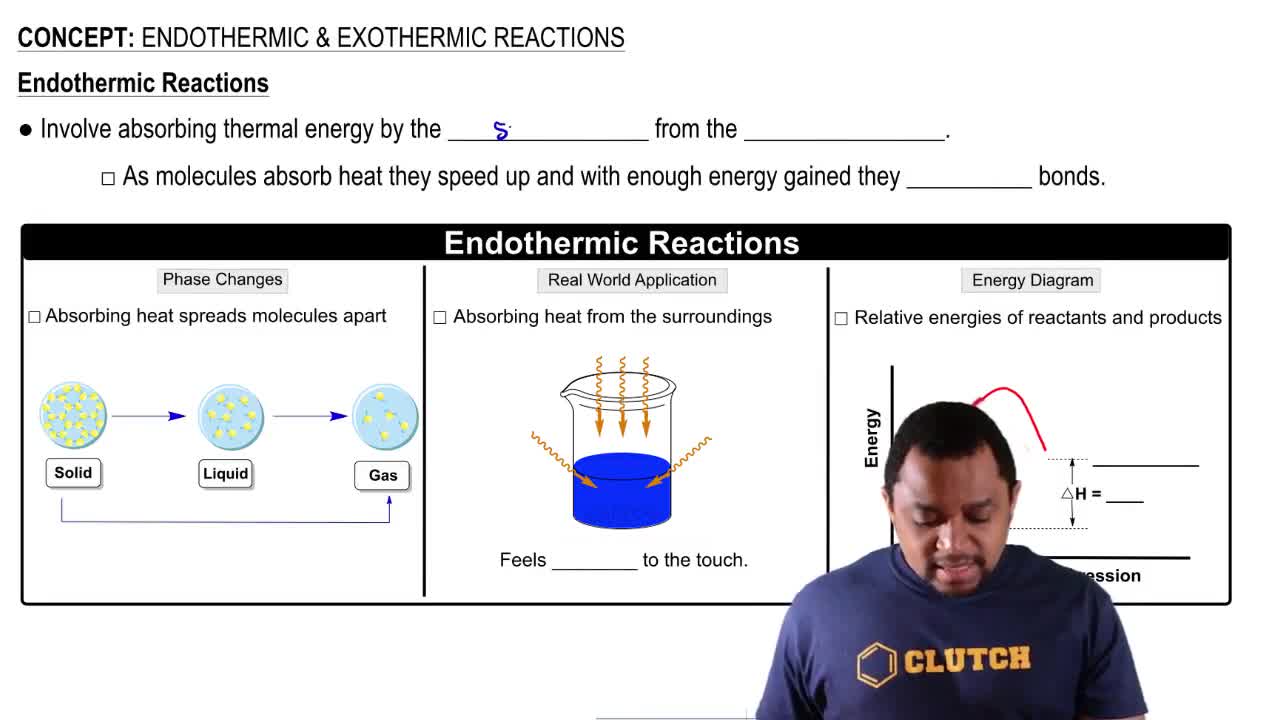
Reactions can be classified as endothermic or exothermic based on their heat exchange with the surroundings. Endothermic reactions absorb heat, while exothermic reactions release heat. The temperature dependence of the equilibrium constant K is influenced by the nature of the reaction; for endothermic reactions, increasing temperature increases K, while for exothermic reactions, it decreases K.
추천 영상:
가이드 코스
02:30
Endothermic & Exothermic Reactions

Equilibrium Constant (K)

The equilibrium constant (K) quantifies the ratio of the concentrations of products to reactants at equilibrium for a given reaction at a specific temperature. It provides insight into the extent of a reaction and how it shifts in response to changes in conditions. Understanding how K varies with temperature is crucial for predicting the direction of a reaction's shift when temperature changes.
추천 영상:
가이드 코스
01:14
Equilibrium Constant K
관련 실천
교과서 질문

The oxidation of glucose (C6H12O6) in body tissue produces CO2 and H2O. In contrast, anaerobic decomposition, which occurs during fermentation, produces ethanol (C2H5OH) and CO2.

(b) Compare the maximum work that can be obtained from these processes under standard conditions.

C6H12O6(s) + 6 O2(g) ⇌ 6 CO2(g) + 6 H2O(l)

C6H12O6(s) ⇌ 2 C2H5OH(l) + 2 CO2(g)

627
views
교과서 질문

Using the data in Appendix C and given the pressures listed, calculate Kp and ΔG for each of the following reactions:

(a) N2(g) + 3 H2(g) → 2 NH3(g) PN2 = 2.6 atm, PH2 = 5.9 atm, PNH3 = 1.2 atm

(b) 2 N2H4(g) + 2 NO2(g) → 3 N2(g) + 4 H2O(g) PN2H4 = PNO2 = 5.0 × 10⁻² atm, PN2 = 0.5 atm, PH2O = 0.3 atm

(c) N2H4(g) → N2(g) + 2 H2(g) PN2H4 = 0.5 atm, PN2 = 1.5 atm, PH2 = 2.5 atm

807
views
교과서 질문

The oxidation of glucose (C6H12O6) in body tissue produces CO2 and H2O. In contrast, anaerobic decomposition, which occurs during fermentation, produces ethanol (C2H5OH) and CO2.

(a) Using data given in Appendix C, compare the equilibrium constants for the following reactions:

C6H12O6(s) + 6 O2(g) ⇌ 6 CO2(g) + 6 H2O(l)

C6H12O6(s) ⇌ 2 C2H5OH(l) + 2 CO2(g)

995
views
교과서 질문

(a) For each of the following reactions, predict the sign of ΔH° and ΔS° without doing any calculations. (i) 2 Mg(s) + O2 (g) ⇌ 2 MgO(s) (ii) 2 KI(s) ⇌ 2 K(g) + I2(g) (iii) Na2(g) ⇌ 2 Na(g) (iv) 2 V2O5(s) ⇌ 4 V(s) + 5 O2(g)

860
views
교과서 질문

(b) Based on your general chemical knowledge, predict which of these reactions will have K>1. (i) 2 Mg(s) + O2 (g) ⇌ 2 MgO(s) (ii) 2 KI(s) ⇌ 2 K(g) + I2(g) (iii) Na2(g) ⇌ 2 Na(g) (iv) 2 V2O5(s) ⇌ 4 V(s) + 5 O2(g)

369
views