Ch.19 - Chemical Thermodynamics
Brown - Chemistry: The Central Science 14th Edition
Brown14th EditionChemistry: The Central ScienceISBN: 9780134414232당신이 사용하는 게 아니라요?교과서 변경
19장, 문제 69b

Consider the following reaction between oxides of nitrogen: NO2(g) + N2O(g) → 3 NO(g) (b) Calculate ΔG at 800 K, assuming that ΔH° and ΔS° do not change with temperature. Under standard conditions is the reaction spontaneous at 800 K?

검증된 단계별 안내
1
Identify the given values: \( \Delta H^\circ \) (standard enthalpy change) and \( \Delta S^\circ \) (standard entropy change) for the reaction. These values are typically found in thermodynamic tables.
Use the Gibbs free energy equation: \( \Delta G = \Delta H - T \Delta S \), where \( T \) is the temperature in Kelvin. Substitute the given temperature (800 K) into the equation.
Calculate \( \Delta G \) using the values of \( \Delta H^\circ \) and \( \Delta S^\circ \) along with the temperature. Remember to convert \( \Delta S^\circ \) from J/mol·K to kJ/mol·K if necessary, to match the units of \( \Delta H^\circ \).
Determine the spontaneity of the reaction by analyzing the sign of \( \Delta G \). If \( \Delta G < 0 \), the reaction is spontaneous under standard conditions at 800 K. If \( \Delta G > 0 \), the reaction is non-spontaneous.
Conclude whether the reaction is spontaneous at 800 K under standard conditions based on the calculated \( \Delta G \).

비슷한 문제에 대한 검증된 영상 답변:

이 영상 해법은 위 문제에 도움이 된다고 튜터들이 추천한 것입니다.
영상 길이:
10m

주요 개념

질문에 올바르게 답하기 위해 반드시 이해해야 하는 핵심 개념들은 다음과 같습니다.

Gibbs Free Energy (ΔG)

Gibbs Free Energy (ΔG) is a thermodynamic potential that measures the maximum reversible work obtainable from a thermodynamic system at constant temperature and pressure. It is calculated using the equation ΔG = ΔH - TΔS, where ΔH is the change in enthalpy, T is the temperature in Kelvin, and ΔS is the change in entropy. A negative ΔG indicates that a reaction is spontaneous under the given conditions.
추천 영상:
가이드 코스
01:51
Gibbs Free Energy of Reactions

Enthalpy (ΔH) and Entropy (ΔS)

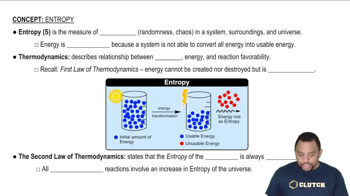
Enthalpy (ΔH) is the total heat content of a system, reflecting the energy required to break and form bonds during a reaction. Entropy (ΔS) measures the degree of disorder or randomness in a system. Both ΔH and ΔS are crucial for determining the spontaneity of a reaction through their influence on ΔG, particularly at varying temperatures.
추천 영상:
가이드 코스
02:46
Entropy in Thermodynamics

Spontaneity of Reactions

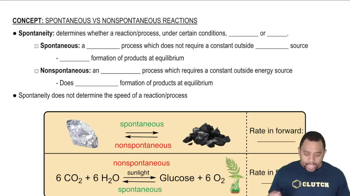
The spontaneity of a reaction refers to whether a reaction can occur without external intervention. A reaction is spontaneous if ΔG is negative, indicating that the products are favored at equilibrium. Factors such as temperature, enthalpy, and entropy changes play significant roles in determining spontaneity, especially in reactions involving gases and temperature variations.
추천 영상:
가이드 코스
04:20
Spontaneity of Processes