
Ch.19 - Chemical Thermodynamics
Brown - Chemistry: The Central Science 14th Edition
Brown14th EditionChemistry: The Central ScienceISBN: 9780134414232당신이 사용하는 게 아니라요?교과서 변경
19장, 문제 95a

Consider the following three reactions: (i) Ti(s) + 2 Cl2(g) → TiCl4(1g) (a) For each of the reactions, use data in Appendix C to calculate ΔH°, ΔG°, K, and ΔS ° at 25 °C.

검증된 단계별 안내
1
Identify the standard enthalpies of formation (ΔHf°) for each reactant and product from Appendix C. For the reaction Ti(s) + 2 Cl2(g) → TiCl4(l), find the ΔHf° values for Ti(s), Cl2(g), and TiCl4(l).
Calculate the standard enthalpy change (ΔH°) for the reaction using the formula: ΔH° = ΣΔHf°(products) - ΣΔHf°(reactants). Plug in the values you found for each substance.
Identify the standard Gibbs free energy of formation (ΔGf°) for each reactant and product from Appendix C. Use these values to calculate the standard Gibbs free energy change (ΔG°) for the reaction using the formula: ΔG° = ΣΔGf°(products) - ΣΔGf°(reactants).
Calculate the standard entropy change (ΔS°) for the reaction using the formula: ΔS° = ΣS°(products) - ΣS°(reactants). Use the standard molar entropy values (S°) from Appendix C for each reactant and product.
Determine the equilibrium constant (K) at 25 °C using the relationship between ΔG° and K, which is given by the equation: ΔG° = -RT ln(K), where R is the gas constant (8.314 J/mol·K) and T is the temperature in Kelvin (298 K for 25 °C). Solve for K.

비슷한 문제에 대한 검증된 영상 답변:

이 영상 해법은 위 문제에 도움이 된다고 튜터들이 추천한 것입니다.
영상 길이:
5m

주요 개념

질문에 올바르게 답하기 위해 반드시 이해해야 하는 핵심 개념들은 다음과 같습니다.

Thermodynamics

Thermodynamics is the study of energy transformations and the relationships between heat, work, and energy. In chemical reactions, it helps determine the changes in enthalpy (ΔH°), Gibbs free energy (ΔG°), and entropy (ΔS°). Understanding these concepts is crucial for predicting the spontaneity and equilibrium of reactions.
추천 영상:
가이드 코스
01:18
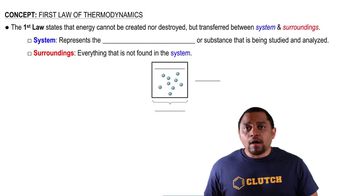
First Law of Thermodynamics

Gibbs Free Energy

Gibbs free energy (G) is a thermodynamic potential that measures the maximum reversible work obtainable from a thermodynamic system at constant temperature and pressure. The change in Gibbs free energy (ΔG°) indicates whether a reaction is spontaneous (ΔG° < 0) or non-spontaneous (ΔG° > 0) under standard conditions.
추천 영상:
가이드 코스
01:51
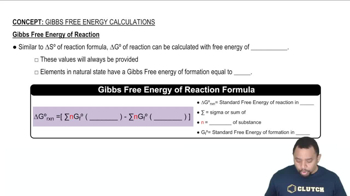
Gibbs Free Energy of Reactions

Equilibrium Constant (K)

The equilibrium constant (K) is a dimensionless value that expresses the ratio of the concentrations of products to reactants at equilibrium for a given reaction at a specific temperature. It is related to the Gibbs free energy change (ΔG°) by the equation ΔG° = -RT ln(K), where R is the gas constant and T is the temperature in Kelvin.
추천 영상:
가이드 코스
01:14
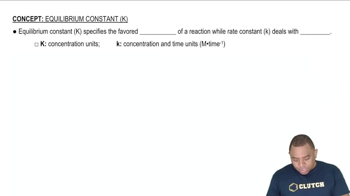
Equilibrium Constant K
관련 실천
교과서 질문

Trouton’s rule states that for many liquids at their normal boiling points, the standard molar entropy of vaporization is about 88 J/mol‐K. b. Look up the normal boiling point of Br2 in a chemistry handbook or at the WebElements website (www.webelements.com) and compare it to your calculation. What are the possible sources of error, or incorrect assumptions, in the calculation?

2574
views
교과서 질문

Using the data in Appendix C and given the pressures listed, calculate Kp and ΔG for each of the following reactions:

(a) N2(g) + 3 H2(g) → 2 NH3(g) PN2 = 2.6 atm, PH2 = 5.9 atm, PNH3 = 1.2 atm

(b) 2 N2H4(g) + 2 NO2(g) → 3 N2(g) + 4 H2O(g) PN2H4 = PNO2 = 5.0 × 10⁻² atm, PN2 = 0.5 atm, PH2O = 0.3 atm

(c) N2H4(g) → N2(g) + 2 H2(g) PN2H4 = 0.5 atm, PN2 = 1.5 atm, PH2 = 2.5 atm

807
views
교과서 질문

Consider the following three reactions: (i) Ti(s) + 2 Cl2(g) → TiCl4(1g) (ii) C2H6(g) + 7 Cl2(g) → 2 CCl4(g) + 6 HCl(g) (iii) BaO(s) + CO2(g) → BaCO3(s) (c) For each of the reactions, predict the manner in which the change in free energy varies with an increase in temperature.

371
views
교과서 질문

Consider the following three reactions: (i) Ti(s) + 2 Cl2(g) → TiCl4(1g) (ii) C2H6(g) + 7 Cl2(g) → 2 CCl4(g) + 6 HCl(g) (iii) BaO(s) + CO2(g) → BaCO3(s) (b) Which of these reactions are spontaneous under standard conditions at 25 °C?

1
views
교과서 질문

(c) In general, under which condition is ΔG°f more positive (less negative) than ΔH°f ? (i) When the temperature is high, (ii) when the reaction is reversible, (iii) when ΔS°f is negative.

582
views