Ch.19 - Chemical Thermodynamics
Brown - Chemistry: The Central Science 14th Edition
Brown14th EditionChemistry: The Central ScienceISBN: 9780134414232당신이 사용하는 게 아니라요?교과서 변경
19장, 문제 77

Consider the reaction 2 NO2(g) → N2O4(g). (a) Using data from Appendix C, calculate ΔG° at 298 K. (b) Calculate ΔG at 298 K if the partial pressures of NO2 and N2O4 are 0.40 atm and 1.60 atm, respectively.

검증된 단계별 안내
1
Step 1: To calculate ΔG° at 298 K, we need to use the formula ΔG° = ΔH° - TΔS°. The values for ΔH° and ΔS° can be found in Appendix C for NO2 and N2O4. Remember that ΔH° and ΔS° for the reaction are calculated as the difference between the products and reactants, taking into account their stoichiometric coefficients.
Step 2: After finding the values for ΔH° and ΔS°, substitute them into the formula along with the temperature in Kelvin (298 K) to calculate ΔG°.
Step 3: To calculate ΔG at 298 K with the given partial pressures, we need to use the formula ΔG = ΔG° + RTlnQ, where R is the gas constant (8.314 J/(mol·K)), T is the temperature in Kelvin, and Q is the reaction quotient.
Step 4: The reaction quotient Q is calculated as the ratio of the product of the concentrations (or pressures) of the products to the product of the concentrations (or pressures) of the reactants, each raised to the power of their stoichiometric coefficients. In this case, Q = [N2O4]/[NO2]2 = (1.60 atm)/(0.40 atm)2.
Step 5: Substitute the values for ΔG°, R, T, and Q into the formula to calculate ΔG.

비슷한 문제에 대한 검증된 영상 답변:

이 영상 해법은 위 문제에 도움이 된다고 튜터들이 추천한 것입니다.
영상 길이:
8m
도움이 되었나요?

주요 개념

질문에 올바르게 답하기 위해 반드시 이해해야 하는 핵심 개념들은 다음과 같습니다.

Gibbs Free Energy (ΔG)

Gibbs Free Energy (ΔG) is a thermodynamic potential that measures the maximum reversible work obtainable from a thermodynamic system at constant temperature and pressure. It is a crucial concept in predicting the spontaneity of a reaction; a negative ΔG indicates a spontaneous process, while a positive ΔG suggests non-spontaneity. The standard Gibbs free energy change (ΔG°) is calculated under standard conditions, typically at 1 atm and 298 K.
추천 영상:
가이드 코스
01:51
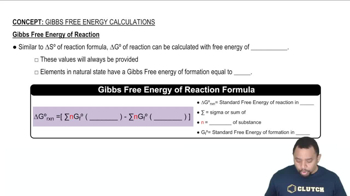
Gibbs Free Energy of Reactions

Standard Gibbs Free Energy Change (ΔG°)

The standard Gibbs Free Energy Change (ΔG°) is the change in Gibbs free energy for a reaction when all reactants and products are in their standard states (1 M concentration for solutions, 1 atm pressure for gases) at a specified temperature, usually 298 K. It is derived from the standard enthalpy and entropy changes of the reaction using the equation ΔG° = ΔH° - TΔS°. This value helps in determining the favorability of a reaction under standard conditions.
추천 영상:
가이드 코스
00:32
Standard Gibbs Free Energy and Temperature

Reaction Quotient (Q) and its Relation to ΔG

The reaction quotient (Q) is a measure of the relative amounts of products and reactants present in a reaction at any point in time, calculated using the partial pressures or concentrations of the species involved. It is used to determine the direction in which a reaction will proceed to reach equilibrium. The relationship between ΔG and Q is given by the equation ΔG = ΔG° + RT ln(Q), where R is the gas constant and T is the temperature in Kelvin. This equation allows for the calculation of ΔG under non-standard conditions.
추천 영상:
가이드 코스
00:49
Reaction Quotient Q