Ch.19 - Chemical Thermodynamics
Brown - Chemistry: The Central Science 14th Edition
Brown14th EditionChemistry: The Central ScienceISBN: 9780134414232당신이 사용하는 게 아니라요?교과서 변경
19장, 문제 13

Indicate whether each statement is true or false. (a) A reaction that is spontaneous in one direction will be nonspontaneous in the reverse direction under the same reaction conditions. (b) All spontaneous processes are fast. (c) Most spontaneous processes are reversible. (d) An isothermal process is one in which the system loses no heat. (e) The maximum amount of work can be accomplished by an irreversible process rather than a reversible one.

검증된 단계별 안내
1
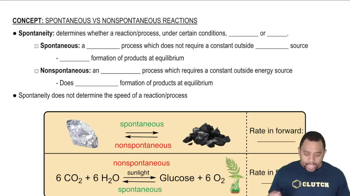
Step 1: Understand the concept of spontaneity in chemical reactions. A spontaneous reaction is one that occurs naturally under given conditions. If a reaction is spontaneous in one direction, it will be nonspontaneous in the reverse direction under the same conditions.
Step 2: Consider the speed of spontaneous processes. Spontaneity does not imply speed. A spontaneous process can be fast or slow, depending on the reaction kinetics.
Step 3: Examine the reversibility of spontaneous processes. Most spontaneous processes are irreversible because they tend to move towards equilibrium, increasing the entropy of the universe.
Step 4: Define an isothermal process. An isothermal process occurs at a constant temperature, but it does not necessarily mean that no heat is exchanged. Heat can be transferred to maintain the temperature.
Step 5: Compare work done in reversible and irreversible processes. The maximum amount of work is done in a reversible process, as it is carried out infinitely slowly, allowing the system to remain in equilibrium with its surroundings.

비슷한 문제에 대한 검증된 영상 답변:

이 영상 해법은 위 문제에 도움이 된다고 튜터들이 추천한 것입니다.
영상 길이:
2m
도움이 되었나요?

주요 개념

질문에 올바르게 답하기 위해 반드시 이해해야 하는 핵심 개념들은 다음과 같습니다.

Spontaneity of Reactions

A spontaneous reaction is one that occurs without external intervention, typically characterized by a decrease in free energy. If a reaction is spontaneous in one direction, it implies that the reverse reaction is nonspontaneous under the same conditions, as the system tends to move towards equilibrium.
추천 영상:
가이드 코스
04:20
Spontaneity of Processes

Reversibility of Processes

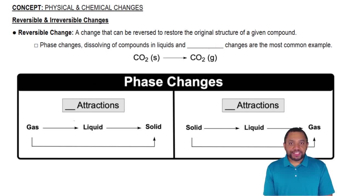
A reversible process is one that can proceed in both directions without a net change in the system and its surroundings. While many spontaneous processes are irreversible due to factors like entropy increase, some can be reversible, particularly in ideal conditions. However, most spontaneous processes are not reversible in practice.
추천 영상:
가이드 코스
03:40
Reversible Changes in Matter

Isothermal Processes

An isothermal process occurs at a constant temperature, meaning that the system exchanges heat with its surroundings to maintain thermal equilibrium. This does not imply that the system loses no heat; rather, it can absorb or release heat while keeping the temperature constant, which is crucial in thermodynamic calculations.
추천 영상:
가이드 코스
04:20
Spontaneity of Processes