Ch.19 - Chemical Thermodynamics
Brown - Chemistry: The Central Science 14th Edition
Brown14th EditionChemistry: The Central ScienceISBN: 9780134414232당신이 사용하는 게 아니라요?교과서 변경
19장, 문제 7

Methanol (CH3OH) can be made by the controlled oxidation of methane: CH4(g) + 1/2 O2(g) → CH3OH(g) (c) Calculate ΔG° at 298 K. Under standard conditions, is the reaction spontaneous at this temperature? (d) Is there a temperature at which the reaction would be at equilibrium under standard conditions and that is low enough so that the compounds involved are likely to be stable?

검증된 단계별 안내
1
To calculate ΔG° at 298 K, use the equation ΔG° = ΔH° - TΔS°. You will need the standard enthalpy change (ΔH°) and the standard entropy change (ΔS°) for the reaction.
Look up the standard enthalpy of formation (ΔH°f) and standard entropy (S°) values for each compound involved in the reaction: CH4(g), O2(g), and CH3OH(g).
Calculate ΔH° for the reaction using the formula: ΔH° = Σ(ΔH°f of products) - Σ(ΔH°f of reactants).
Calculate ΔS° for the reaction using the formula: ΔS° = Σ(S° of products) - Σ(S° of reactants).
Determine if the reaction is spontaneous at 298 K by evaluating the sign of ΔG°. If ΔG° is negative, the reaction is spontaneous under standard conditions. For part (d), consider the temperature at which ΔG° = 0, which indicates equilibrium, and assess the stability of the compounds at that temperature.

주요 개념

질문에 올바르게 답하기 위해 반드시 이해해야 하는 핵심 개념들은 다음과 같습니다.

Gibbs Free Energy (ΔG)

Gibbs Free Energy (ΔG) is a thermodynamic potential that measures the maximum reversible work obtainable from a thermodynamic system at constant temperature and pressure. It is used to predict the spontaneity of a reaction: if ΔG is negative, the reaction is spontaneous; if positive, it is non-spontaneous. At equilibrium, ΔG equals zero, indicating no net change in the concentrations of reactants and products.
추천 영상:
가이드 코스
01:51
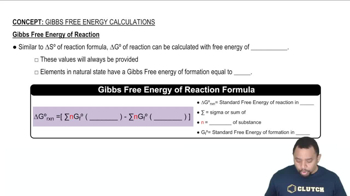
Gibbs Free Energy of Reactions

Standard Conditions

Standard conditions refer to a set of specific conditions used to measure and compare thermodynamic properties, typically defined as 1 bar of pressure and a specified temperature, usually 298 K (25°C). Under these conditions, the standard Gibbs free energy change (ΔG°) can be calculated, allowing for the assessment of reaction spontaneity and equilibrium. It is crucial to ensure that all reactants and products are in their standard states.
추천 영상:
가이드 코스
01:10
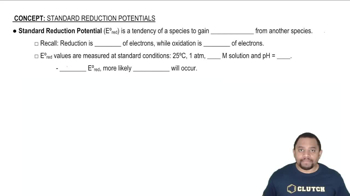
Standard Reduction Potentials

Equilibrium and Temperature

Chemical equilibrium occurs when the rates of the forward and reverse reactions are equal, resulting in constant concentrations of reactants and products. The temperature can influence the position of equilibrium, as described by Le Chatelier's principle. For a reaction to be at equilibrium under standard conditions, the temperature must be adjusted to a point where ΔG° equals zero, which can be determined using the van 't Hoff equation, considering the stability of the compounds involved.
추천 영상:
가이드 코스
04:04
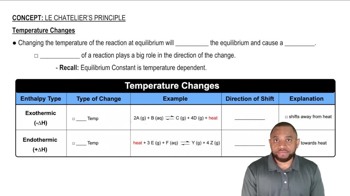
Temperature and Equilibrium Shifts