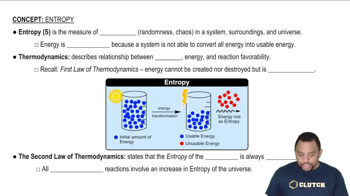
Indicate whether each statement is true or false. (c) In a certain spontaneous process the system undergoes an entropy change of 4.2 J/K; therefore, the entropy change of the surroundings must be -4.2 J/K.
Ch.19 - Chemical Thermodynamics
19장, 문제 24a
The element gallium (Ga) freezes at 29.8 °C, and its molar enthalpy of fusion is ΔHfus = 5.59 kJ/mol. (a) When molten gallium solidifies to Ga(s) at its normal melting point, is ΔS positive or negative?
검증된 단계별 안내1
Start by understanding the process: When molten gallium solidifies, it changes from a liquid to a solid state.
Recall that entropy (ΔS) is a measure of disorder or randomness in a system.
In general, the entropy of a solid is lower than that of a liquid because the particles in a solid are more ordered.
Since the process involves going from a more disordered state (liquid) to a more ordered state (solid), the change in entropy (ΔS) is expected to be negative.
Therefore, when molten gallium solidifies, ΔS is negative because the system becomes more ordered.

비슷한 문제에 대한 검증된 영상 답변:
이 영상 해법은 위 문제에 도움이 된다고 튜터들이 추천한 것입니다.
영상 길이:
51s주요 개념
질문에 올바르게 답하기 위해 반드시 이해해야 하는 핵심 개념들은 다음과 같습니다.
Entropy (ΔS)
Entropy is a measure of the disorder or randomness in a system. In thermodynamics, a positive change in entropy (ΔS > 0) indicates an increase in disorder, while a negative change (ΔS < 0) signifies a decrease in disorder. When a substance transitions from a liquid to a solid, such as gallium solidifying, the molecules become more ordered, leading to a negative change in entropy.
추천 영상:
가이드 코스
Entropy in Thermodynamics
Phase Changes
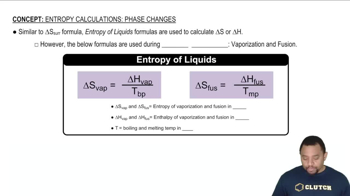
Phase changes refer to the transitions between different states of matter, such as solid, liquid, and gas. During these transitions, energy is either absorbed or released, affecting the system's enthalpy and entropy. In the case of gallium, when it freezes at its melting point, it releases energy (enthalpy of fusion), which is crucial for understanding the thermodynamic behavior of the substance during solidification.
추천 영상:
가이드 코스
Entropy in Phase Changes
Enthalpy of Fusion (ΔH<sub>fus</sub>)
The enthalpy of fusion is the amount of energy required to change a substance from solid to liquid at its melting point, or vice versa. For gallium, the enthalpy of fusion is 5.59 kJ/mol, indicating the energy released when it solidifies. This energy change is important for determining the thermodynamic properties of the phase transition and its impact on entropy.
추천 영상:
가이드 코스
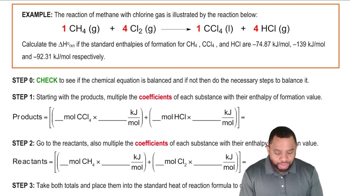
Enthalpy of Formation Example 1
관련 실천
교과서 질문
266
views
교과서 질문
The normal boiling point of Br2(𝑙) is 58.8 °C, and its molar enthalpy of vaporization is Δ𝐻vap=29.6kJ/mol. (b) Calculate the value of Δ𝑆 when 1.00 mol of Br2(𝑙) is vaporized at 58.8 °C.
443
views
교과서 질문
The element gallium (Ga) freezes at 29.8 °C, and its molar enthalpy of fusion is ΔHfus = 5.59 kJ/mol. (b) Calculate the value of ΔS when 60.0 g of Ga(l) solidifies at 29.8 °C.
872
views
교과서 질문
The normal boiling point of Br2(l) is 58.8 °C, and its molar enthalpy of vaporization is ΔHvap = 29.6 kJ/mol. (a) When Br2(l) boils at its normal boiling point, does its entropy increase or decrease?
927
views
교과서 질문
(a) Does the entropy of the surroundings increase for spontaneous processes?
567
views