Ch.19 - Chemical Thermodynamics
Brown - Chemistry: The Central Science 14th Edition
Brown14th EditionChemistry: The Central ScienceISBN: 9780134414232당신이 사용하는 게 아니라요?교과서 변경
19장, 문제 84d

The Kb for methylamine (CH3NH2) at 25 °C is given in Appendix D. (d) What is the value of ΔG when [H+] = 6.7 × 10⁻⁹ M, [CH3NH3+] = 2.4 × 10⁻³ M, and [CH3NH2] = 0.098 M?

검증된 단계별 안내
1
Identify the reaction for the dissociation of methylamine (CH3NH2) in water: CH3NH2 + H2O ⇌ CH3NH3+ + OH-. The equilibrium constant for this reaction is the base dissociation constant, Kb.
Use the relationship between the equilibrium constant (K) and the Gibbs free energy change (ΔG) given by the equation: ΔG = -RT ln(K), where R is the universal gas constant (8.314 J/mol·K) and T is the temperature in Kelvin.
Calculate the reaction quotient (Q) using the given concentrations: Q = ([CH3NH3+][OH-])/[CH3NH2]. Note that [OH-] can be found using the relation [OH-] = Kw/[H+], where Kw is the ion product of water (1.0 × 10^-14 at 25 °C).
Determine the equilibrium constant (K) using the given Kb value for methylamine from Appendix D. This value is necessary to compare with the reaction quotient (Q).
Calculate ΔG using the equation ΔG = ΔG° + RT ln(Q), where ΔG° is the standard Gibbs free energy change calculated from Kb, and Q is the reaction quotient calculated in the previous step.

비슷한 문제에 대한 검증된 영상 답변:

이 영상 해법은 위 문제에 도움이 된다고 튜터들이 추천한 것입니다.
영상 길이:
3m

주요 개념

질문에 올바르게 답하기 위해 반드시 이해해야 하는 핵심 개념들은 다음과 같습니다.

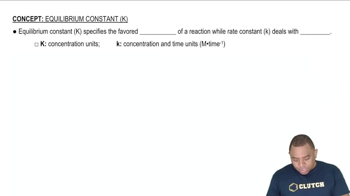
Equilibrium Constant (K)

The equilibrium constant (K) quantifies the ratio of concentrations of products to reactants at equilibrium for a given reaction. For a base like methylamine, Kb indicates its strength as a base, reflecting how well it accepts protons in solution. Understanding Kb is essential for calculating the Gibbs free energy change (ΔG) in the context of acid-base equilibria.
추천 영상:
가이드 코스
01:14
Equilibrium Constant K

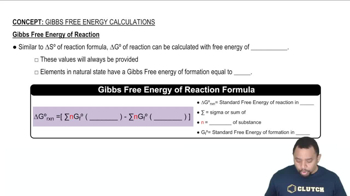
Gibbs Free Energy (ΔG)

Gibbs free energy (ΔG) is a thermodynamic potential that measures the maximum reversible work obtainable from a thermodynamic system at constant temperature and pressure. It is calculated using the formula ΔG = ΔG° + RT ln(Q), where Q is the reaction quotient. This concept is crucial for determining the spontaneity of a reaction and how it relates to the concentrations of reactants and products.
추천 영상:
가이드 코스
01:51
Gibbs Free Energy of Reactions

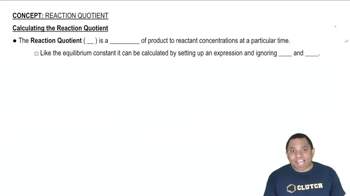
Reaction Quotient (Q)

The reaction quotient (Q) is a measure of the relative concentrations of products and reactants at any point in a reaction, similar to K but not necessarily at equilibrium. It is calculated using the same expression as K but with the current concentrations. Comparing Q to K helps predict the direction of the reaction and is vital for calculating ΔG in the given scenario.
추천 영상:
가이드 코스
00:49
Reaction Quotient Q