Ch.19 - Chemical Thermodynamics
Brown - Chemistry: The Central Science 14th Edition
Brown14th EditionChemistry: The Central ScienceISBN: 9780134414232당신이 사용하는 게 아니라요?교과서 변경
19장, 문제 83b

The value of Ka for nitrous acid (HNO2) at 25 °C is given in Appendix D. (b) By using the value of Ka, calculate ΔG° for the dissociation of nitrous acid in aqueous solution.

검증된 단계별 안내
1
Identify the relationship between the equilibrium constant (K_a) and the standard Gibbs free energy change (ΔG°) using the equation: ΔG° = -RT ln(K_a), where R is the universal gas constant and T is the temperature in Kelvin.
Convert the temperature from Celsius to Kelvin by adding 273.15 to the given temperature in Celsius (25 °C).
Look up the value of the gas constant R, which is 8.314 J/(mol·K).
Substitute the values of R, T, and K_a into the equation ΔG° = -RT ln(K_a) to calculate ΔG°.
Ensure that the units are consistent, particularly that the temperature is in Kelvin and the gas constant is in J/(mol·K), to obtain ΔG° in joules per mole.

비슷한 문제에 대한 검증된 영상 답변:

이 영상 해법은 위 문제에 도움이 된다고 튜터들이 추천한 것입니다.
영상 길이:
1m

주요 개념

질문에 올바르게 답하기 위해 반드시 이해해야 하는 핵심 개념들은 다음과 같습니다.

Acid Dissociation Constant (K<sub>a</sub>)

The acid dissociation constant (K<sub>a</sub>) quantifies the strength of an acid in solution. It is defined as the equilibrium constant for the dissociation of an acid into its conjugate base and a proton. A higher K<sub>a</sub> value indicates a stronger acid, as it dissociates more completely in water.
추천 영상:
가이드 코스
01:14
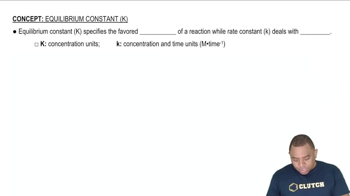
Equilibrium Constant K

Gibbs Free Energy (ΔG°)

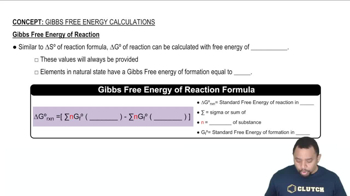
Gibbs free energy (ΔG°) is a thermodynamic potential that measures the maximum reversible work obtainable from a thermodynamic process at constant temperature and pressure. For a reaction, a negative ΔG° indicates that the reaction is spontaneous, while a positive ΔG° suggests non-spontaneity. The relationship between ΔG° and K<sub>a</sub> can be expressed using the equation ΔG° = -RT ln(K<sub>a</sub>), where R is the gas constant and T is the temperature in Kelvin.
추천 영상:
가이드 코스
01:51
Gibbs Free Energy of Reactions

Equilibrium and Reaction Quotient

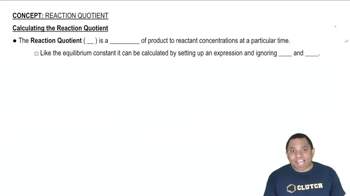
Equilibrium in a chemical reaction occurs when the rates of the forward and reverse reactions are equal, resulting in constant concentrations of reactants and products. The reaction quotient (Q) compares the current concentrations of products and reactants to those at equilibrium. For weak acids like nitrous acid, understanding how to calculate Q and relate it to K<sub>a</sub> is essential for determining the direction of the reaction and calculating ΔG°.
추천 영상:
가이드 코스
00:49
Reaction Quotient Q