
Ch.19 - Chemical Thermodynamics
Brown - Chemistry: The Central Science 14th Edition
Brown14th EditionChemistry: The Central ScienceISBN: 9780134414232당신이 사용하는 게 아니라요?교과서 변경
19장, 문제 58

Use data in Appendix C to calculate ΔH°, ΔS°, and ΔG° at 25 °C for each of the following reactions.
a. 4 Cr(s) + 3 O2(g) → 2 Cr2O3(s)
b. BaCO3(s) → BaO(s) + CO2(g)
c. 2 P(s) + 10 HF(g) → 2 PF5(g) + 5 H2(g)
d. K(s) + O2(g) → KO2(s)

검증된 단계별 안내
1
1. To calculate the ΔH° (standard enthalpy change), ΔS° (standard entropy change), and ΔG° (standard Gibbs free energy change) for the reaction, you need to use the standard enthalpy, entropy, and Gibbs free energy of formation values from Appendix C for each substance involved in the reaction. The standard enthalpy, entropy, and Gibbs free energy of a reaction are calculated using the formula: ΔH° = Σ ΔHf°(products) - Σ ΔHf°(reactants), ΔS° = Σ S°(products) - Σ S°(reactants), and ΔG° = ΔH° - TΔS°, respectively, where T is the absolute temperature in Kelvin (25 °C = 298.15 K).
2. For ΔH°, look up the standard enthalpy of formation (ΔHf°) for each substance in the reaction in Appendix C. Multiply each ΔHf° by the stoichiometric coefficient in the balanced chemical equation and add up the values for the products and reactants separately. Then subtract the sum for the reactants from the sum for the products.
3. For ΔS°, look up the standard molar entropy (S°) for each substance in the reaction in Appendix C. Multiply each S° by the stoichiometric coefficient in the balanced chemical equation and add up the values for the products and reactants separately. Then subtract the sum for the reactants from the sum for the products.
4. For ΔG°, use the ΔH° and ΔS° values you calculated and the temperature in Kelvin. Substitute these values into the equation ΔG° = ΔH° - TΔS° to calculate ΔG°.
5. Remember to check the units. The standard enthalpy and Gibbs free energy of formation are usually given in kJ/mol, while the standard molar entropy is given in J/(mol·K). You may need to convert units to make them consistent.

비슷한 문제에 대한 검증된 영상 답변:

이 영상 해법은 위 문제에 도움이 된다고 튜터들이 추천한 것입니다.
영상 길이:
5m

주요 개념

질문에 올바르게 답하기 위해 반드시 이해해야 하는 핵심 개념들은 다음과 같습니다.

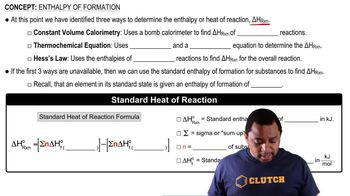
Enthalpy (ΔH°)

Enthalpy, represented as ΔH°, is a measure of the total heat content of a system at constant pressure. It reflects the energy absorbed or released during a chemical reaction. A negative ΔH° indicates an exothermic reaction, while a positive ΔH° signifies an endothermic reaction. Understanding how to calculate ΔH° using standard enthalpies of formation is crucial for evaluating the energy changes in the given reaction.
추천 영상:
가이드 코스
02:34
Enthalpy of Formation

Entropy (ΔS°)

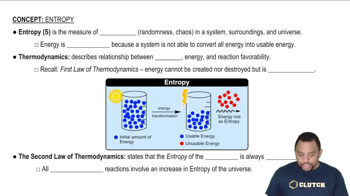
Entropy, denoted as ΔS°, is a measure of the disorder or randomness in a system. It quantifies the number of ways a system can be arranged, with higher entropy indicating greater disorder. In chemical reactions, changes in entropy can influence the spontaneity of the reaction. Calculating ΔS° involves using standard molar entropies, which helps in understanding how the reaction's disorder changes from reactants to products.
추천 영상:
가이드 코스
02:46
Entropy in Thermodynamics

Gibbs Free Energy (ΔG°)

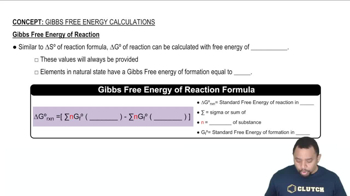
Gibbs Free Energy, represented as ΔG°, combines enthalpy and entropy to determine the spontaneity of a reaction at constant temperature and pressure. The relationship ΔG° = ΔH° - TΔS° indicates that a negative ΔG° suggests a spontaneous reaction, while a positive ΔG° indicates non-spontaneity. Calculating ΔG° is essential for predicting whether the reaction will occur under standard conditions, such as at 25 °C.
추천 영상:
가이드 코스
01:51
Gibbs Free Energy of Reactions