
Ch.2 - Atoms, Molecules, and Ions
Brown - Chemistry: The Central Science 14th Edition
Brown14th EditionChemistry: The Central ScienceISBN: 9780134414232당신이 사용하는 게 아니라요?교과서 변경
2장, 문제 13b

A chemist finds that 30.82 g of nitrogen will react with 17.60, 35.20, 70.40, or 88.00 g of oxygen to form four different compounds. (b) How do the numbers in part (a) support Dalton's atomic theory?

검증된 단계별 안내
1
Identify the mass ratios of oxygen that react with a fixed mass of nitrogen in each compound. These ratios are 17.60 g, 35.20 g, 70.40 g, and 88.00 g of oxygen for every 30.82 g of nitrogen.
Calculate the ratios of the masses of oxygen to nitrogen for each compound. For example, for the first compound, divide the mass of oxygen (17.60 g) by the mass of nitrogen (30.82 g). Repeat this for each of the other masses of oxygen.
Observe that each of these ratios represents a simple whole number multiple of the smallest ratio. This suggests that the different amounts of oxygen are combining in whole number ratios to form different compounds.
Relate these findings to Dalton's atomic theory, which states that elements combine in simple whole number ratios to form compounds. The data supports this by showing that oxygen atoms combine with nitrogen atoms in fixed, simple, whole number ratios to form different chemical compounds.
Conclude that the experimental data provided supports Dalton's atomic theory, reinforcing the idea that atoms are indivisible particles that combine in specific proportions to form compounds.

비슷한 문제에 대한 검증된 영상 답변:

이 영상 해법은 위 문제에 도움이 된다고 튜터들이 추천한 것입니다.
영상 길이:
6m
도움이 되었나요?

주요 개념

질문에 올바르게 답하기 위해 반드시 이해해야 하는 핵심 개념들은 다음과 같습니다.

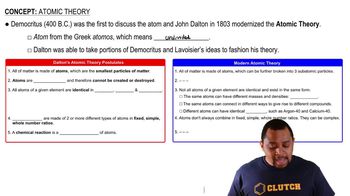
Dalton's Atomic Theory

Dalton's Atomic Theory posits that matter is composed of indivisible atoms, which combine in fixed ratios to form compounds. This theory explains the conservation of mass in chemical reactions and the distinct properties of different substances based on their atomic composition. The idea that elements combine in specific proportions is fundamental to understanding chemical reactions.
추천 영상:
가이드 코스
05:22
Dalton's Atomic Theory

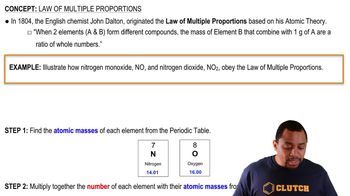
Law of Multiple Proportions

The Law of Multiple Proportions states that when two elements form more than one compound, the masses of one element that combine with a fixed mass of the other can be expressed as a ratio of small whole numbers. This principle supports Dalton's theory by demonstrating that compounds are formed from atoms in specific, quantifiable ratios, as seen in the varying amounts of oxygen reacting with nitrogen.
추천 영상:
가이드 코스
03:32
Law of Multiple Proportions

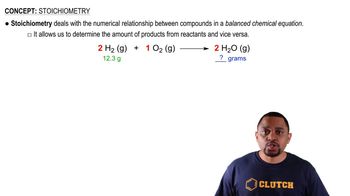
Stoichiometry

Stoichiometry is the calculation of reactants and products in chemical reactions based on the conservation of mass and the mole concept. It allows chemists to predict the amounts of substances consumed and produced in a reaction. In the context of the question, stoichiometry helps to analyze how different masses of oxygen react with a fixed mass of nitrogen, illustrating the principles of Dalton's theory.
추천 영상:
가이드 코스
01:16
Stoichiometry Concept
관련 실천
교과서 질문

In a series of experiments, a chemist prepared three different compounds that contain only iodine and fluorine and determined the mass of each element in each compound: Compound Mass of Iodine (g) Mass of Fluorine (g) 1 4.75 3.56 2 7.64 3.43 3 9.41 9.86 (b) How do the numbers in part (a) support the atomic theory?

649
views
1
rank
교과서 질문

In a series of experiments, a chemist prepared three different compounds that contain only iodine and fluorine and determined the mass of each element in each compound: Compound Mass of Iodine (g) Mass of Fluorine (g) 1 4.75 3.56 2 7.64 3.43 3 9.41 9.86 (a) Calculate the mass of fluorine per gram of iodine in Compound 3.

742
views
교과서 질문

A chemist finds that 30.82 g of nitrogen will react with 17.60, 35.20, 70.40, or 88.00 g of oxygen to form four different compounds. (a) Calculate the mass of oxygen per gram of nitrogen in each compound. 30.82 g N and 70.40 g O

371
views
교과서 질문

A chemist finds that 30.82 g of nitrogen will react with 17.60, 35.20, 70.40, or 88.00 g of oxygen to form four different compounds. (a) Calculate the mass of oxygen per gram of nitrogen in each compound. 30.82 g N and 35.20 g O

505
views
교과서 질문

In a series of experiments, a chemist prepared three different compounds that contain only iodine and fluorine and determined the mass of each element in each compound: Compound Mass of Iodine (g) Mass of Fluorine (g) 1 4.75 3.56 2 7.64 3.43 3 9.41 9.86 (a) Calculate the mass of fluorine per gram of iodine in Compound 1 and 2.

882
views
교과서 질문

A chemist finds that 30.82 g of nitrogen will react with 17.60, 35.20, 70.40, or 88.00 g of oxygen to form four different compounds. (a) Calculate the mass of oxygen per gram of nitrogen in each compound. 30.82 g N and 88.00 g O

1274
views