Ch.2 - Atoms, Molecules, and Ions
Brown - Chemistry: The Central Science 14th Edition
Brown14th EditionChemistry: The Central ScienceISBN: 9780134414232당신이 사용하는 게 아니라요?교과서 변경
2장, 문제 25a

(a) Define atomic number and mass number.

검증된 단계별 안내
1
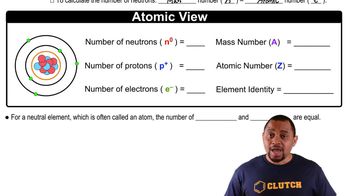
The atomic number of an element is defined as the number of protons in the nucleus of an atom of that element. It is denoted by the symbol \( Z \).
The atomic number determines the identity of an element and its position in the periodic table. For example, hydrogen has an atomic number of 1, meaning it has one proton.
The mass number of an atom is the total number of protons and neutrons in its nucleus. It is denoted by the symbol \( A \).
The mass number is calculated by adding the number of protons (atomic number) and the number of neutrons in the atom. For example, if an atom has 6 protons and 6 neutrons, its mass number is 12.
While the atomic number is unique to each element, the mass number can vary among atoms of the same element due to the presence of isotopes, which are atoms with the same number of protons but different numbers of neutrons.

비슷한 문제에 대한 검증된 영상 답변:

이 영상 해법은 위 문제에 도움이 된다고 튜터들이 추천한 것입니다.
영상 길이:
1m
도움이 되었나요?

주요 개념

질문에 올바르게 답하기 위해 반드시 이해해야 하는 핵심 개념들은 다음과 같습니다.

Atomic Number

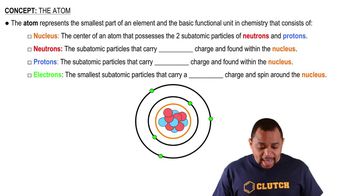
The atomic number is the number of protons found in the nucleus of an atom. It uniquely identifies an element and determines its position on the periodic table. For example, hydrogen has an atomic number of 1, indicating it has one proton. The atomic number also influences the chemical properties of the element.
추천 영상:

Mass Number

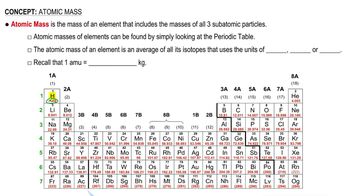
The mass number is the total number of protons and neutrons in an atom's nucleus. It is not the same as atomic mass, which is a weighted average of all isotopes of an element. For instance, carbon has a mass number of 12, which means it typically has 6 protons and 6 neutrons. The mass number helps in identifying isotopes of an element.
추천 영상:

Isotopes

Isotopes are variants of a particular chemical element that have the same number of protons but different numbers of neutrons, resulting in different mass numbers. For example, carbon-12 and carbon-14 are isotopes of carbon, with mass numbers of 12 and 14, respectively. Isotopes can exhibit different physical properties and stability, influencing their applications in fields like medicine and archaeology.
추천 영상: