
Ch.2 - Atoms, Molecules, and Ions
Brown - Chemistry: The Central Science 14th Edition
Brown14th EditionChemistry: The Central ScienceISBN: 9780134414232당신이 사용하는 게 아니라요?교과서 변경
2장, 문제 108

Consider a sample of calcium carbonate in the form of a cube measuring 2.005 in. on each edge. If the sample has a density of 2.71 g>cm3, how many oxygen atoms does it contain?

검증된 단계별 안내
1
Convert the edge length of the cube from inches to centimeters using the conversion factor 1 inch = 2.54 cm.
Calculate the volume of the cube in cubic centimeters using the formula for the volume of a cube: \( V = \text{edge length}^3 \).
Determine the mass of the calcium carbonate sample by multiplying its volume by the given density (2.71 g/cm³).
Calculate the number of moles of calcium carbonate (CaCO₃) using its molar mass (100.09 g/mol).
Determine the number of oxygen atoms by multiplying the moles of CaCO₃ by Avogadro's number (6.022 x 10²³ atoms/mol) and the number of oxygen atoms per formula unit of CaCO₃ (3 oxygen atoms).

비슷한 문제에 대한 검증된 영상 답변:

이 영상 해법은 위 문제에 도움이 된다고 튜터들이 추천한 것입니다.
영상 길이:
3m

주요 개념

질문에 올바르게 답하기 위해 반드시 이해해야 하는 핵심 개념들은 다음과 같습니다.

Density and Volume Calculation

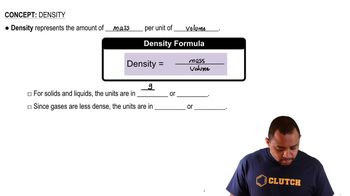
Density is defined as mass per unit volume, typically expressed in grams per cubic centimeter (g/cm³). To find the mass of the calcium carbonate cube, we first calculate its volume using the formula for the volume of a cube (V = side³). Given the edge length of 2.005 inches, we convert this measurement to centimeters and then apply the density to find the mass.
추천 영상:
가이드 코스
01:56
Density Concepts

Molar Mass and Chemical Composition

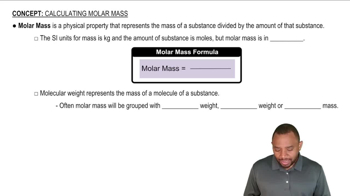
Calcium carbonate (CaCO₃) consists of calcium (Ca), carbon (C), and oxygen (O) atoms. To determine the number of oxygen atoms in the sample, we need to know the molar mass of CaCO₃, which is approximately 100.09 g/mol. This allows us to convert the mass of the sample into moles of CaCO₃, from which we can calculate the total number of oxygen atoms, considering that each molecule contains three oxygen atoms.
추천 영상:
가이드 코스
02:11
Molar Mass Concept

Avogadro's Number

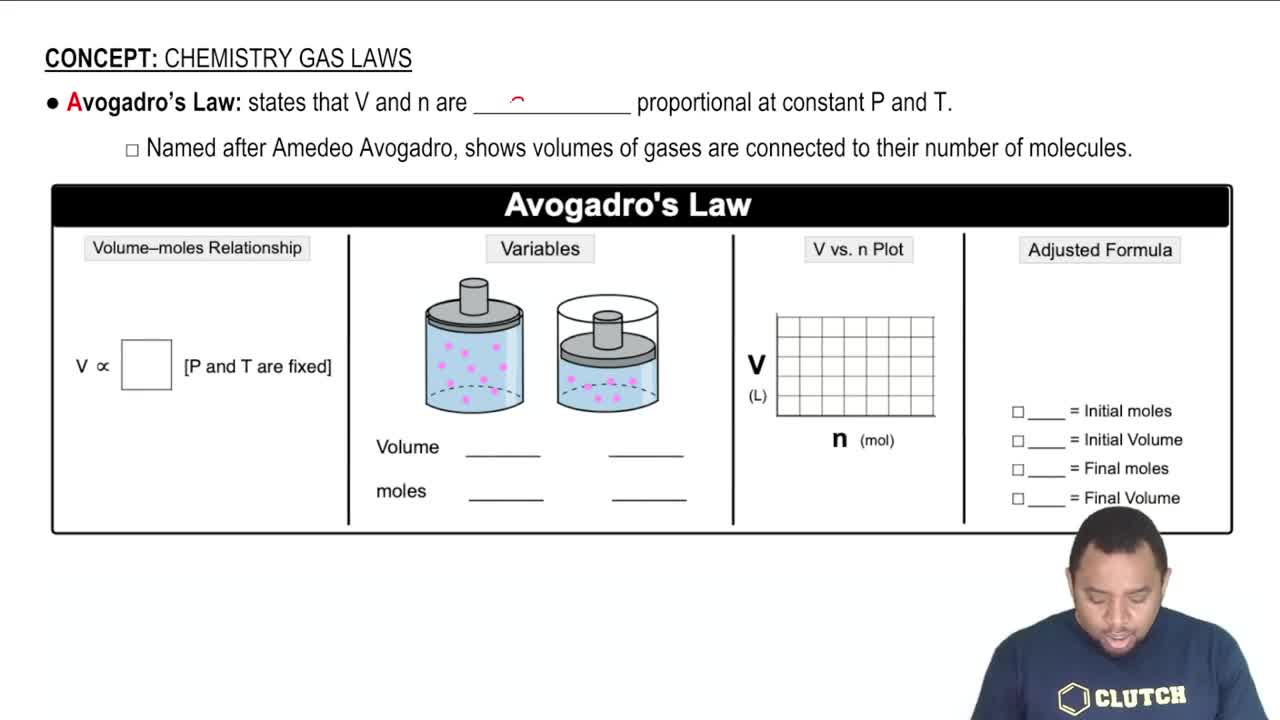
Avogadro's number (6.022 x 10²³) is the number of particles, typically atoms or molecules, in one mole of a substance. After calculating the moles of calcium carbonate in the sample, we can use Avogadro's number to find the total number of molecules present. Multiplying the number of moles of CaCO₃ by three gives the total number of oxygen atoms in the sample.
추천 영상:
관련 실천
교과서 질문

Fill in the blanks in the following table:

Cation Anion Formula Name

Lithium oxide

Fe2+ PO43-

Al2(SO4)3

Copper(II) nitrate

Cr3+ I

MnClO2

Ammonium carbonate

Zinc perchlorate

Complete the third column of the table.

Complete the fourth column of the table.

805
views
교과서 질문

Cyclopropane is an interesting hydrocarbon. Instead of having three carbons in a row, the three carbons form a ring, as shown in this perspective drawing (see Figure 2.18 for a prior example of this kind of drawing):

Cyclopropane was at one time used as an anesthetic, but its use was discontinued, in part because it is highly flammable. (b) The three carbon atoms are necessarily in a plane. What do the different wedges mean?

822
views
교과서 질문

Fill in the blanks in the following table:

Cation Anion Formula Name

Lithium oxide

Fe2+ PO43-

Al2(SO4)3

Copper(II) nitrate

Cr3+ I

MnClO2

Ammonium carbonate

Zinc perchlorate

Complete the first column of the table.

864
views
교과서 질문

Elements in the same group of the periodic table often form oxyanions with the same general formula. The anions are also named in a similar fashion. Based on these observations, suggest a chemical formula or name, as appropriate, for each of the following ions: (a) BrO4- (b) SeO32- (c) arsenate ion

486
views
교과서 질문

Cyclopropane is an interesting hydrocarbon. Instead of having three carbons in a row, the three carbons form a ring, as shown in this perspective drawing (see Figure 2.18 for a prior example of this kind of drawing):

Cyclopropane was at one time used as an anesthetic, but its use was discontinued, in part because it is highly flammable. (a) How does it differ from that of propane?

503
views