Ch.2 - Atoms, Molecules, and Ions
Brown - Chemistry: The Central Science 14th Edition
Brown14th EditionChemistry: The Central ScienceISBN: 9780134414232당신이 사용하는 게 아니라요?교과서 변경
2장, 문제 96

Copper (Cu) consists of two naturally occurring isotopes with masses of 62.9296 and 64.9278 u. (a) How many protons and neutrons are in the nucleus of each isotope? Write the complete atomic symbol for each, showing the atomic number and mass number. (b) The average atomic mass of Cu is 63.55 u. Calculate the abundance of each isotope.

검증된 단계별 안내
1
Identify the number of protons in copper (Cu) by referring to its atomic number on the periodic table, which is 29. This number is the same for all isotopes of an element.
Calculate the number of neutrons in each isotope by subtracting the atomic number from the mass number (rounded atomic mass). For the first isotope with a mass of 62.9296 u, round to 63 and subtract the atomic number (63 - 29 = 34 neutrons). For the second isotope with a mass of 64.9278 u, round to 65 and subtract the atomic number (65 - 29 = 36 neutrons).
Write the complete atomic symbol for each isotope. For the first isotope, it is \(^{63}_{29}\text{Cu}\) and for the second isotope, it is \(^{65}_{29}\text{Cu}\).
To calculate the abundance of each isotope, set up the equation for average atomic mass: \(63.55 = (x \times 62.9296) + ((1 - x) \times 64.9278)\), where \(x\) is the fractional abundance of the first isotope and \((1 - x)\) is the fractional abundance of the second isotope.
Solve the equation for \(x\) to find the abundance of each isotope. This involves isolating \(x\) on one side of the equation and solving for its value.

비슷한 문제에 대한 검증된 영상 답변:

이 영상 해법은 위 문제에 도움이 된다고 튜터들이 추천한 것입니다.
영상 길이:
3m

주요 개념

질문에 올바르게 답하기 위해 반드시 이해해야 하는 핵심 개념들은 다음과 같습니다.

Isotopes

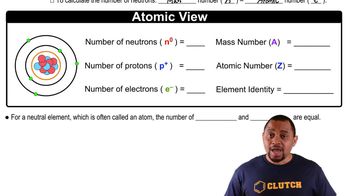
Isotopes are variants of a chemical element that have the same number of protons but different numbers of neutrons, resulting in different mass numbers. For example, copper has two isotopes: one with 29 protons and 34 neutrons (mass number 63) and another with 29 protons and 36 neutrons (mass number 65). Understanding isotopes is crucial for determining the composition and properties of elements.
추천 영상:

Atomic Symbol

The atomic symbol of an element is a notation that represents the element's identity, including its atomic number (number of protons) and mass number (total number of protons and neutrons). For copper, the complete atomic symbols for its isotopes are written as 63Cu and 65Cu, where the superscript indicates the mass number. This notation is essential for distinguishing between different isotopes in chemical equations and calculations.
추천 영상:
가이드 코스
00:52
Lewis Dot Symbols

Average Atomic Mass and Abundance

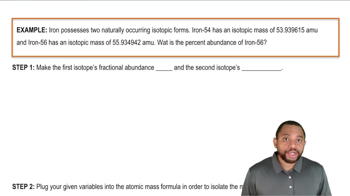
The average atomic mass of an element is a weighted average of the masses of its isotopes, taking into account their relative abundances. To calculate the abundance of each isotope, one can set up equations based on the average atomic mass and the known masses of the isotopes. This concept is vital for understanding how isotopes contribute to the overall mass of an element as found on the periodic table.
추천 영상:
가이드 코스
5:41
Calculating Abundance Example