Ch.2 - Atoms, Molecules, and Ions
Brown - Chemistry: The Central Science 14th Edition
Brown14th EditionChemistry: The Central ScienceISBN: 9780134414232당신이 사용하는 게 아니라요?교과서 변경
2장, 문제 22d

Determine whether each of the following statements is true or false. If false, correct the statement to make it true: (d) The protons in the nucleus of the helium atom are held together by a force called the strong nuclear force.

검증된 단계별 안내
1
1. The statement is true. The protons in the nucleus of the helium atom are indeed held together by a force called the strong nuclear force.
2. The strong nuclear force is one of the four fundamental forces in nature. It is responsible for holding the protons and neutrons together in the nucleus of an atom.
3. Without the strong nuclear force, the protons in the nucleus would repel each other due to their like charges (positive). The strong nuclear force overcomes this electrostatic repulsion and keeps the nucleus intact.
4. Therefore, the statement 'The protons in the nucleus of the helium atom are held together by a force called the strong nuclear force' is correct and does not need any modification.

비슷한 문제에 대한 검증된 영상 답변:

이 영상 해법은 위 문제에 도움이 된다고 튜터들이 추천한 것입니다.
영상 길이:
2m
도움이 되었나요?

주요 개념

질문에 올바르게 답하기 위해 반드시 이해해야 하는 핵심 개념들은 다음과 같습니다.

Strong Nuclear Force

The strong nuclear force is one of the four fundamental forces of nature, responsible for holding protons and neutrons together in an atomic nucleus. It is a short-range force that acts between particles called baryons, which include protons and neutrons. This force is significantly stronger than the electromagnetic force that causes protons to repel each other due to their positive charges, thus allowing the nucleus to remain stable.
추천 영상:
가이드 코스
01:51
Effective Nuclear Charge

Helium Atom Structure

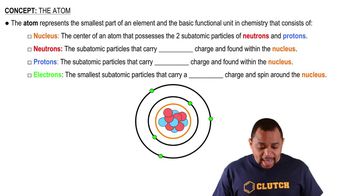
A helium atom consists of two protons, two neutrons, and two electrons. The protons and neutrons are located in the nucleus at the center of the atom, while the electrons orbit around the nucleus. The presence of two protons in the nucleus creates a strong electromagnetic repulsion, which is counteracted by the strong nuclear force, allowing the nucleus to remain intact despite this repulsion.
추천 영상:

Nuclear Stability

Nuclear stability refers to the ability of an atomic nucleus to remain intact without undergoing radioactive decay. This stability is influenced by the balance between the strong nuclear force, which binds nucleons together, and the electromagnetic force, which causes repulsion among protons. In helium, the strong nuclear force effectively overcomes the repulsive forces, resulting in a stable nucleus, which is why helium is a common and stable element.
추천 영상:
가이드 코스
03:29
Band of Stability: Nuclear Fission