Ch.2 - Atoms, Molecules, and Ions
Brown - Chemistry: The Central Science 14th Edition
Brown14th EditionChemistry: The Central ScienceISBN: 9780134414232당신이 사용하는 게 아니라요?교과서 변경
2장, 문제 28

Each of the following isotopes is used in medicine. Indicate the number of protons and neutrons in each isotope: (a) samarium-153 (b) lutetium-177 (c) bismuth-213 (d) molybdenum-99 (e) lead-212 (f) caesium-131.

검증된 단계별 안내
1
Identify the atomic number of each element, which corresponds to the number of protons. This can be found on the periodic table.
For each isotope, the mass number is given in the name (e.g., samarium-153 has a mass number of 153).
Calculate the number of neutrons in each isotope by subtracting the atomic number (number of protons) from the mass number: Neutrons = Mass number - Atomic number.
Repeat the calculation for each isotope: (a) samarium-153, (b) lutetium-177, (c) bismuth-213, (d) molybdenum-99, (e) lead-212, (f) caesium-131.
Summarize the number of protons and neutrons for each isotope based on your calculations.

주요 개념

질문에 올바르게 답하기 위해 반드시 이해해야 하는 핵심 개념들은 다음과 같습니다.

Isotopes

Isotopes are variants of a particular chemical element that have the same number of protons but different numbers of neutrons. This difference in neutron count results in varying atomic masses. For example, carbon-12 and carbon-14 are isotopes of carbon, with 6 protons each but 6 and 8 neutrons, respectively. Understanding isotopes is crucial for identifying the specific properties and applications of elements in fields like medicine.
추천 영상:

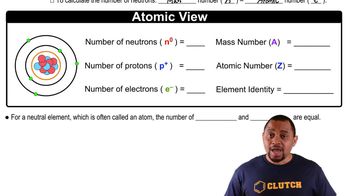
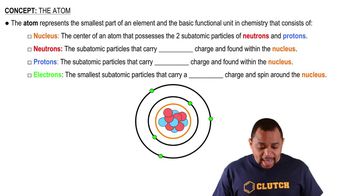
Atomic Structure

The atomic structure consists of protons, neutrons, and electrons, where protons and neutrons reside in the nucleus, and electrons orbit around it. The number of protons defines the element and its position on the periodic table, while the total number of protons and neutrons gives the atomic mass. This structure is fundamental for determining the characteristics of isotopes and their stability, which is particularly relevant in medical applications.
추천 영상:

Nuclear Medicine

Nuclear medicine involves the use of radioactive isotopes for diagnosis and treatment of diseases. Isotopes like samarium-153 and lutetium-177 emit radiation that can target specific tissues, making them useful in treating conditions such as cancer. Understanding the properties of these isotopes, including their half-lives and decay modes, is essential for their effective application in medical therapies and imaging techniques.
추천 영상:
가이드 코스
02:06
Nuclear Binding Energy