Write the molecular and structural formulas for the compounds represented by the following molecular models:
Ch.2 - Atoms, Molecules, and Ions
2장, 문제 55
Fill in the gaps in the following table: Symbol 59Co3+ Protons 34 76 80 Neutrons 46 116 120 Electrons 36 78 Net charge 2+
검증된 단계별 안내1
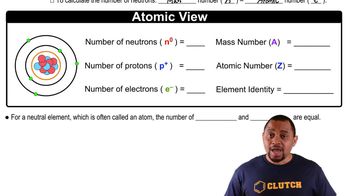
Identify the number of protons for each element using the atomic number, which is equal to the number of protons.
Calculate the number of electrons for each ion by considering the net charge: Electrons = Protons - Charge.
Determine the number of neutrons by subtracting the number of protons from the mass number: Neutrons = Mass Number - Protons.
For the given symbol 59Co3+, identify the number of protons from the periodic table (Co has 27 protons) and calculate the number of electrons considering the charge (27 - 3 = 24 electrons).
Fill in the missing values in the table using the calculated numbers of protons, neutrons, and electrons for each element or ion.

비슷한 문제에 대한 검증된 영상 답변:
이 영상 해법은 위 문제에 도움이 된다고 튜터들이 추천한 것입니다.
영상 길이:
6m주요 개념
질문에 올바르게 답하기 위해 반드시 이해해야 하는 핵심 개념들은 다음과 같습니다.
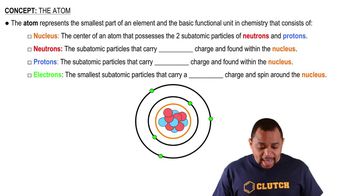
Atomic Structure
Atomic structure refers to the composition of an atom, which includes protons, neutrons, and electrons. Protons are positively charged particles found in the nucleus, while neutrons are neutral particles also located in the nucleus. Electrons are negatively charged and orbit the nucleus. The number of protons determines the element, while the balance of protons and electrons defines the atom's charge.
추천 영상:
가이드 코스
Atom Structure
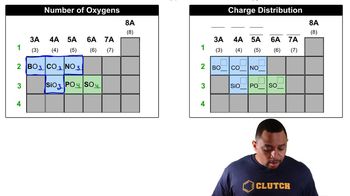
Ions and Charge
Ions are atoms or molecules that have gained or lost one or more electrons, resulting in a net electric charge. A cation, like Co3+, has lost electrons, leading to a positive charge. The net charge of an ion is calculated by subtracting the number of electrons from the number of protons. Understanding how to determine the charge is essential for filling in the gaps in the provided table.
추천 영상:
가이드 코스
Polyatomic Ion Charges
Isotopes
Isotopes are variants of a particular chemical element that have the same number of protons but different numbers of neutrons. This difference in neutrons results in varying atomic masses. For example, cobalt (Co) can have isotopes with different neutron counts, affecting its stability and nuclear properties. Recognizing isotopes is crucial for accurately completing the table regarding neutrons and atomic mass.
추천 영상:
가이드 코스
Isotopes
관련 실천
교과서 질문
909
views
교과서 질문
Write the molecular and structural formulas for the compounds represented by the following models:
745
views
교과서 질문
Using the periodic table, predict the charge of the most stable ion of the following elements: (a) Li (b) Ba (c) Po (d) I
518
views
교과서 질문
Each of the following elements is capable of forming an ion in chemical reactions. By referring to the periodic table, predict the charge of the most stable ion of each: (a) Be (b) Rb (c) As (d) In (e) At.
682
views
교과서 질문
Fill in the gaps in the following table: Symbol 133Cs+ Protons 35 15 Neutrons 46 16 30 Electrons 18 20 Net charge 1- 5+
720
views
교과서 질문
How many of the indicated atoms are represented by each chemical formula: (b) oxygen atoms in Ca(ClO3)2 (c) hydrogen atoms in (NH4)2HPO4?
535
views