Ch.2 - Atoms, Molecules, and Ions
Brown - Chemistry: The Central Science 14th Edition
Brown14th EditionChemistry: The Central ScienceISBN: 9780134414232당신이 사용하는 게 아니라요?교과서 변경
2장, 문제 7

Five of the boxes in the following periodic table are colored. Predict the charge on the ion associated with each of these elements.

검증된 단계별 안내
1
Identify the position of each colored element in the periodic table to determine its group number.
Recall that elements in the same group typically form ions with the same charge due to having the same number of valence electrons.
For main group elements, use the group number to predict the charge: elements in Group 1 form +1 ions, Group 2 form +2 ions, Group 13 form +3 ions, Group 15 form -3 ions, Group 16 form -2 ions, and Group 17 form -1 ions.
Consider any exceptions or special cases, such as transition metals, which may have multiple possible charges.
Write down the predicted charge for each element based on its group and typical ion formation behavior.

비슷한 문제에 대한 검증된 영상 답변:

이 영상 해법은 위 문제에 도움이 된다고 튜터들이 추천한 것입니다.
영상 길이:
1m

주요 개념

질문에 올바르게 답하기 위해 반드시 이해해야 하는 핵심 개념들은 다음과 같습니다.

Periodic Table and Element Groups

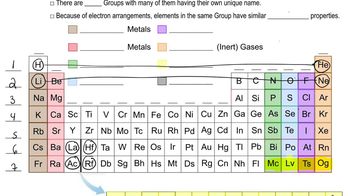
The periodic table organizes elements based on their atomic number and properties. Elements are grouped into columns (groups) that share similar chemical behaviors. For example, alkali metals in Group 1 typically form +1 ions, while halogens in Group 17 usually form -1 ions. Understanding an element's position in the periodic table helps predict its ionic charge.
추천 영상:
가이드 코스
05:33
Periodic Table: Group Names

Ionic Charge and Electron Configuration

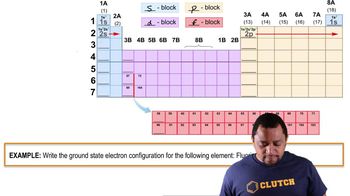
Ionic charge refers to the electrical charge an atom acquires when it loses or gains electrons to achieve a stable electron configuration, often resembling that of noble gases. Metals tend to lose electrons and form positive ions (cations), while nonmetals gain electrons to form negative ions (anions). This concept is crucial for predicting the charges of ions formed by different elements.
추천 영상:
가이드 코스
01:33
Electron Configuration Example

Trends in Ionic Charges

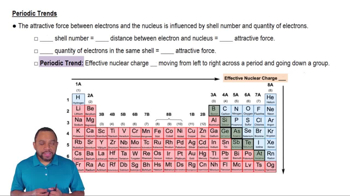
Ionic charges exhibit predictable trends across the periodic table. For instance, elements in the same group often form ions with the same charge due to their similar valence electron configurations. Additionally, as you move from left to right across a period, the tendency to gain electrons increases, leading to more negative charges for nonmetals. Recognizing these trends aids in accurately predicting the charges of ions.
추천 영상:
가이드 코스
2:06
Effective Nuclear Charge Trends