
Ch.2 - Atoms, Molecules, and Ions
Brown - Chemistry: The Central Science 14th Edition
Brown14th EditionChemistry: The Central ScienceISBN: 9780134414232당신이 사용하는 게 아니라요?교과서 변경
2장, 문제 88a

The natural abundance of 3He is 0.000137%. (a) How many protons, neutrons, and electrons are in an atom of 3He?

검증된 단계별 안내
1
3He is an isotope of helium, where the superscript '3' indicates the mass number, which is the sum of protons and neutrons in the nucleus.
Helium (He) is element number 2 on the periodic table, which means it has 2 protons. The number of protons defines the element.
In a neutral atom, the number of electrons equals the number of protons. Therefore, a 3He atom also has 2 electrons.
To find the number of neutrons, subtract the number of protons from the mass number: Neutrons = Mass number - Protons = 3 - 2.
Thus, a 3He atom has 2 protons, 1 neutron, and 2 electrons.

비슷한 문제에 대한 검증된 영상 답변:

이 영상 해법은 위 문제에 도움이 된다고 튜터들이 추천한 것입니다.
영상 길이:
2m

주요 개념

질문에 올바르게 답하기 위해 반드시 이해해야 하는 핵심 개념들은 다음과 같습니다.

Atomic Structure

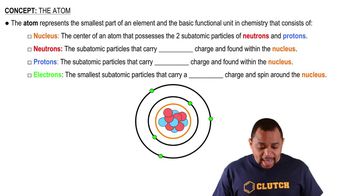
An atom consists of three main subatomic particles: protons, neutrons, and electrons. Protons are positively charged and reside in the nucleus, while neutrons are neutral particles also found in the nucleus. Electrons are negatively charged and orbit the nucleus in electron shells. The number of protons defines the element, while the number of neutrons can vary, leading to different isotopes.
추천 영상:

Isotopes

Isotopes are variants of a particular chemical element that have the same number of protons but different numbers of neutrons. For example, helium-3 (³He) has two protons and one neutron, distinguishing it from the more common helium-4 (⁴He), which has two neutrons. The natural abundance of isotopes can affect their occurrence and applications in various fields, including nuclear science.
추천 영상:

Elemental Composition

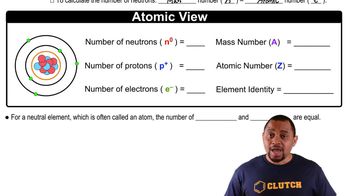
The elemental composition of an atom is determined by its atomic number, which is the number of protons in the nucleus. For helium, the atomic number is 2, indicating it has two protons and, in a neutral atom, two electrons. The number of neutrons can be calculated by subtracting the atomic number from the mass number, which for ³He is 3, resulting in one neutron.
추천 영상:
가이드 코스
04:19
Matter Composition
관련 실천
교과서 질문

Suppose a scientist repeats the Millikan oil-drop experiment but reports the charges on the drops using an unusual (and imaginary) unit called the warmomb (wa). The scientist obtains the following data for four of the drops: Droplet Calculated Charge (wa) A 3.84⨉10−8 B 4.80⨉10−8 C 2.88⨉10−8 D 8.64⨉10−8 (b) From these data, what is the best choice for the charge of the electron in warmombs?

804
views
1
comments
교과서 질문

Suppose a scientist repeats the Millikan oil-drop experiment but reports the charges on the drops using an unusual (and imaginary) unit called the warmomb (wa). The scientist obtains the following data for four of the drops: Droplet Calculated Charge (wa) A 3.84⨉10−8 B 4.80⨉10−8 C 2.88⨉10−8 D 8.64⨉10−8 (d) What is the conversion factor between warmombs and coulombs?

1459
views
교과서 질문

The natural abundance of 3He is 0.000137%. (b) Based on the sum of the masses of their subatomic particles, which is expected to be more massive, an atom of 3He or an atom of 3H (which is also called tritium)?

906
views
교과서 질문

Suppose a scientist repeats the Millikan oil-drop experiment but reports the charges on the drops using an unusual (and imaginary) unit called the warmomb (wa). The scientist obtains the following data for four of the drops: Droplet Calculated Charge (wa) A 3.84⨉10−8 B 4.80⨉10−8 C 2.88⨉10−8 D 8.64⨉10−8 (c) Based on your answer to part (b), how many electrons are there on each of the droplets?

846
views
교과서 질문

The natural abundance of 3He is 0.000137%. (c) Based on your answer to part (b), what would need to be the precision of a mass spectrometer that is able to differentiate between peaks that are due to 3He+ and 3H+?

565
views