The structural formulas of the compounds n-butane and isobutane are shown below. (c) Which formulas—empirical, molecular, or structural—allow you determine these are different compounds?
Ch.2 - Atoms, Molecules, and Ions
2장, 문제 45b
The structural formulas of the compounds n-butane and isobutane are shown below. (b) Determine the empirical formula of each.

검증된 단계별 안내1
Identify the molecular formula of isopentane by counting the number of carbon (C) and hydrogen (H) atoms in the structure.
Identify the molecular formula of hexane by counting the number of carbon (C) and hydrogen (H) atoms in the structure.
Determine the empirical formula of isopentane by finding the simplest whole number ratio of the atoms in its molecular formula.
Determine the empirical formula of hexane by finding the simplest whole number ratio of the atoms in its molecular formula.
Compare the empirical formulas of isopentane and hexane to see if they are the same or different.

비슷한 문제에 대한 검증된 영상 답변:
이 영상 해법은 위 문제에 도움이 된다고 튜터들이 추천한 것입니다.
영상 길이:
1m주요 개념
질문에 올바르게 답하기 위해 반드시 이해해야 하는 핵심 개념들은 다음과 같습니다.
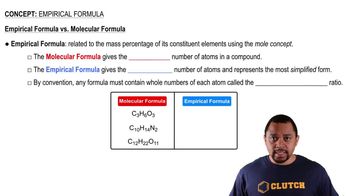
Empirical Formula
The empirical formula of a compound represents the simplest whole-number ratio of the elements present in that compound. It is derived from the molecular formula by dividing the subscripts of each element by their greatest common divisor. For example, the empirical formula for C6H12 is CH2, indicating that for every carbon atom, there are two hydrogen atoms.
추천 영상:
가이드 코스
Empirical vs Molecular Formula
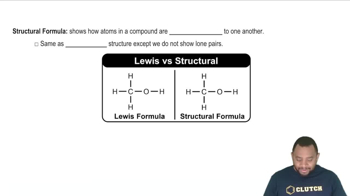
Structural Formulas
Structural formulas depict the arrangement of atoms within a molecule, showing how the atoms are bonded to each other. They provide insight into the molecular geometry and can help identify isomers, which are compounds with the same molecular formula but different structural arrangements. Understanding structural formulas is crucial for determining the empirical formula accurately.
추천 영상:
가이드 코스
Structural Formula
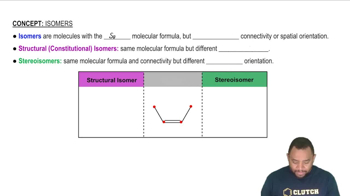
Isomers
Isomers are compounds that share the same molecular formula but differ in the arrangement of atoms, leading to different properties. For instance, n-butane and isobutane are structural isomers, meaning they have the same molecular formula (C4H10) but different structural formulas. Recognizing isomers is essential when calculating empirical formulas, as it affects the interpretation of the molecular structure.
추천 영상:
가이드 코스
Isomers
관련 실천
교과서 질문
605
views
교과서 질문
What are the molecular and empirical formulas for each of the following compounds? Write the molecular formula for the following compound.
532
views
교과서 질문
For each of the following elements, write its chemical symbol, determine the name of the group to which it belongs (Table 2.3), and indicate whether it is a metal, metalloid, or nonmetal: (a) polonium (b) strontium (c) neon (d) rubidium (e) sulfur.
603
views
교과서 질문
Ball-and-stick representations of benzene, a colorless liquid often used in organic chemistry reactions, and acetylene, a gas used as a fuel for high-temperature welding, are shown below. (a) Determine the molecular formula of each.
427
views