Ch.2 - Atoms, Molecules, and Ions
Brown - Chemistry: The Central Science 14th Edition
Brown14th EditionChemistry: The Central ScienceISBN: 9780134414232당신이 사용하는 게 아니라요?교과서 변경
2장, 문제 66b,c

Which of the following are ionic, and which are molecular? (b) NaI (c) Zr(NO3)2

검증된 단계별 안내
1
Step 1: Understand the difference between ionic and molecular compounds. Ionic compounds are formed from the electrostatic attraction between cations and anions, typically involving a metal and a non-metal. Molecular compounds, also known as covalent compounds, are formed by the sharing of electrons between non-metals.
Step 2: Identify the elements in the compound NaI. Sodium (Na) is a metal, and iodine (I) is a non-metal.
Step 3: Determine the type of bond formed between the elements. Since Na is a metal and I is a non-metal, they are likely to form an ionic bond.
Step 4: Recall that in ionic compounds, the metal loses electrons to become a positively charged cation, while the non-metal gains electrons to become a negatively charged anion.
Step 5: Conclude that NaI is an ionic compound because it consists of a metal (Na) and a non-metal (I) forming an ionic bond.

비슷한 문제에 대한 검증된 영상 답변:

이 영상 해법은 위 문제에 도움이 된다고 튜터들이 추천한 것입니다.
영상 길이:
7m

주요 개념

질문에 올바르게 답하기 위해 반드시 이해해야 하는 핵심 개념들은 다음과 같습니다.

Ionic Compounds

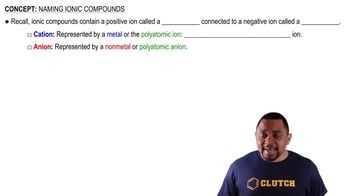
Ionic compounds are formed when atoms transfer electrons, resulting in the formation of charged ions. These compounds typically consist of a metal and a non-metal, where the metal donates electrons to become a positively charged cation, and the non-metal accepts electrons to become a negatively charged anion. The electrostatic attraction between these oppositely charged ions holds the compound together.
추천 영상:
가이드 코스
02:11
Ionic Compounds Naming

Molecular Compounds

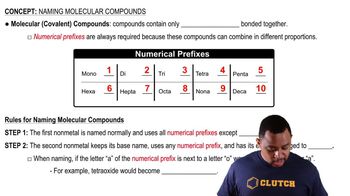
Molecular compounds are formed when two or more non-metal atoms share electrons through covalent bonds. Unlike ionic compounds, molecular compounds do not consist of ions but rather discrete molecules. These compounds often have lower melting and boiling points compared to ionic compounds and can exist in various states (solid, liquid, gas) at room temperature.
추천 영상:
가이드 코스
02:06
Naming Molecular Compounds

Identifying Ionic vs. Molecular

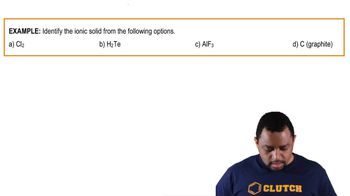
To determine whether a compound is ionic or molecular, one can examine its constituent elements. Compounds formed from metals and non-metals are typically ionic, while those formed from non-metals are molecular. Additionally, the presence of a polyatomic ion can indicate an ionic compound, while the absence of such ions and the presence of covalent bonds suggest a molecular compound.
추천 영상:
가이드 코스
00:34
Ionic Solid Identification Example