Ch.2 - Atoms, Molecules, and Ions
Brown - Chemistry: The Central Science 14th Edition
Brown14th EditionChemistry: The Central ScienceISBN: 9780134414232당신이 사용하는 게 아니라요?교과서 변경
2장, 문제 49d,e,f

Write the empirical formula corresponding to each of the following molecular formulas: (d) P4O10 (e) C6H4Cl2 (f) B3N3H6.

검증된 단계별 안내
1
Identify the subscripts in the molecular formula C_6H_4Cl_2, which are 6 for carbon (C), 4 for hydrogen (H), and 2 for chlorine (Cl).
Find the greatest common divisor (GCD) of the subscripts 6, 4, and 2. The GCD is 2.
Divide each subscript in the molecular formula by the GCD. This gives: C: 6/2 = 3, H: 4/2 = 2, Cl: 2/2 = 1.
Write the empirical formula using the simplified subscripts: C_3H_2Cl.
The empirical formula is the simplest whole number ratio of atoms in the compound, which is C_3H_2Cl.

비슷한 문제에 대한 검증된 영상 답변:

이 영상 해법은 위 문제에 도움이 된다고 튜터들이 추천한 것입니다.
영상 길이:
1m
도움이 되었나요?

주요 개념

질문에 올바르게 답하기 위해 반드시 이해해야 하는 핵심 개념들은 다음과 같습니다.

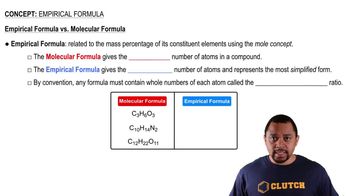
Empirical Formula

The empirical formula of a compound represents the simplest whole-number ratio of the elements present in that compound. It does not provide information about the actual number of atoms in a molecule but rather the relative proportions of each element. For example, the empirical formula for glucose (C6H12O6) is CH2O, indicating a 1:2:1 ratio of carbon, hydrogen, and oxygen.
추천 영상:
가이드 코스
02:26
Empirical vs Molecular Formula

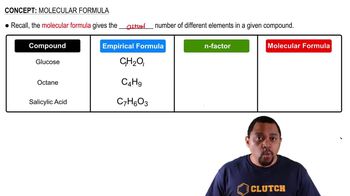
Molecular Formula

The molecular formula of a compound indicates the actual number of each type of atom in a molecule. It provides more specific information than the empirical formula, as it reflects the true composition of the substance. For instance, the molecular formula C6H4Cl2 shows that there are six carbon atoms, four hydrogen atoms, and two chlorine atoms in each molecule of the compound.
추천 영상:
가이드 코스
02:08
Determining Molecular Formulas

Reduction of Ratios

To derive the empirical formula from a molecular formula, one must reduce the ratios of the elements to their simplest form. This involves dividing the number of atoms of each element by their greatest common divisor. In the case of C6H4Cl2, the ratio of carbon to hydrogen to chlorine is already in its simplest form, leading to the empirical formula C3H2Cl.
추천 영상:
가이드 코스
02:14
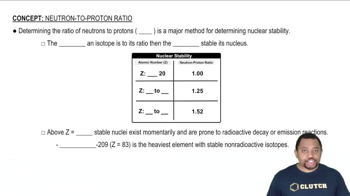
Neutron-Proton Ratio