Ch.20 - Electrochemistry
Brown - Chemistry: The Central Science 14th Edition
Brown14th EditionChemistry: The Central ScienceISBN: 9780134414232당신이 사용하는 게 아니라요?교과서 변경
20장, 문제 91a

(a) A Cr3+(aq) solution is electrolyzed, using a current of 7.60 A. What mass of Cr(s) is plated out after 2.00 days?

검증된 단계별 안내
1
Identify the relevant electrochemical reaction: \( \text{Cr}^{3+} + 3e^- \rightarrow \text{Cr(s)} \).
Calculate the total charge passed through the solution using the formula \( Q = I \times t \), where \( I \) is the current (7.60 A) and \( t \) is the time in seconds (2.00 days converted to seconds).
Determine the number of moles of electrons transferred using Faraday's constant (\( F = 96485 \text{ C/mol} \)) with the formula \( \text{moles of } e^- = \frac{Q}{F} \).
Use the stoichiometry of the reaction to find the moles of chromium plated out. Since 3 moles of electrons are required to plate out 1 mole of Cr, divide the moles of electrons by 3.
Calculate the mass of chromium using the molar mass of chromium (\( \text{Cr} = 51.9961 \text{ g/mol} \)) and the moles of chromium obtained in the previous step.

비슷한 문제에 대한 검증된 영상 답변:

이 영상 해법은 위 문제에 도움이 된다고 튜터들이 추천한 것입니다.
영상 길이:
3m
도움이 되었나요?

주요 개념

질문에 올바르게 답하기 위해 반드시 이해해야 하는 핵심 개념들은 다음과 같습니다.

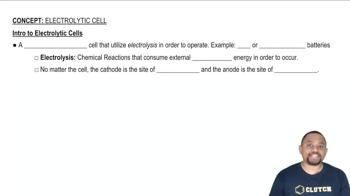
Electrolysis

Electrolysis is a chemical process that uses electrical energy to drive a non-spontaneous reaction. In this process, an electric current is passed through an electrolyte solution, causing the ions to migrate towards the electrodes, where they undergo reduction or oxidation. For the Cr3+ ions in the solution, electrolysis will result in the deposition of chromium metal at the cathode.
추천 영상:
가이드 코스
01:21
The Electrolytic Cell

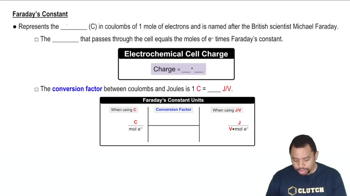
Faraday's Laws of Electrolysis

Faraday's Laws of Electrolysis quantify the relationship between the amount of substance transformed at an electrode and the quantity of electric charge passed through the electrolyte. The first law states that the mass of a substance deposited or liberated at an electrode is directly proportional to the total electric charge passed. This relationship is crucial for calculating the mass of chromium plated out in the given electrolysis scenario.
추천 영상:
가이드 코스
01:40
Faraday's Constant in Electrochemistry

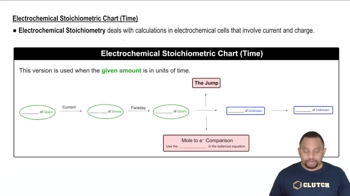
Current and Time Relationship

The relationship between current, time, and charge is fundamental in electrolysis calculations. The total charge (Q) can be calculated using the formula Q = I × t, where I is the current in amperes and t is the time in seconds. This charge is then used in conjunction with Faraday's laws to determine the mass of the substance deposited, making it essential for solving the problem of how much chromium is plated out.
추천 영상:
가이드 코스
02:16
Electrochemical Stoichiometric Chart (Time)