Ch.20 - Electrochemistry
Brown - Chemistry: The Central Science 14th Edition
Brown14th EditionChemistry: The Central ScienceISBN: 9780134414232당신이 사용하는 게 아니라요?교과서 변경
20장, 문제 57a

A cell has a standard cell potential of +0.177 V at 298 K. What is the value of the equilibrium constant for the reaction
(a) if n = 1?

검증된 단계별 안내
1
Identify the relationship between the standard cell potential (E°) and the equilibrium constant (K) using the Nernst equation at standard conditions.
Use the formula: E° = (RT/nF) * ln(K), where R is the universal gas constant (8.314 J/mol·K), T is the temperature in Kelvin (298 K), n is the number of moles of electrons transferred in the reaction, and F is Faraday's constant (96485 C/mol).
Rearrange the formula to solve for the equilibrium constant (K): ln(K) = (nF * E°) / (RT).
Substitute the given values into the equation: n = 1, E° = 0.177 V, R = 8.314 J/mol·K, T = 298 K, and F = 96485 C/mol.
Calculate ln(K) using the substituted values, and then find K by taking the exponential of ln(K).

비슷한 문제에 대한 검증된 영상 답변:

이 영상 해법은 위 문제에 도움이 된다고 튜터들이 추천한 것입니다.
영상 길이:
7m

주요 개념

질문에 올바르게 답하기 위해 반드시 이해해야 하는 핵심 개념들은 다음과 같습니다.

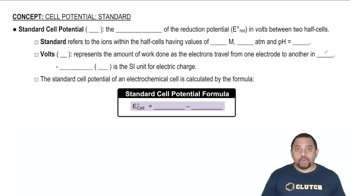
Standard Cell Potential

The standard cell potential (E°) is the measure of the voltage produced by an electrochemical cell under standard conditions (1 M concentration, 1 atm pressure, and 298 K). It indicates the tendency of a chemical reaction to occur spontaneously; a positive E° suggests a spontaneous reaction, while a negative E° indicates non-spontaneity.
추천 영상:
가이드 코스
01:27
Standard Cell Potential

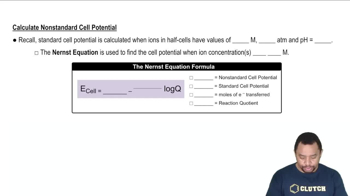
Nernst Equation

The Nernst equation relates the cell potential to the concentrations of the reactants and products in an electrochemical reaction. It can be used to calculate the equilibrium constant (K) by connecting E° to the Gibbs free energy change (ΔG°) and the reaction quotient (Q), allowing for the determination of K at equilibrium.
추천 영상:
가이드 코스
01:17
The Nernst Equation

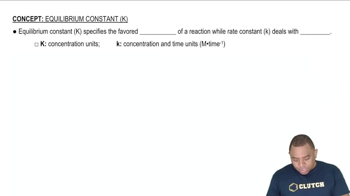
Equilibrium Constant (K)

The equilibrium constant (K) quantifies the ratio of the concentrations of products to reactants at equilibrium for a given reaction at a specific temperature. It is derived from the standard cell potential and reflects the extent to which a reaction proceeds; a larger K indicates a greater tendency for products to form, while a smaller K suggests a preference for reactants.
추천 영상:
가이드 코스
01:14
Equilibrium Constant K