
Ch.20 - Electrochemistry
Brown - Chemistry: The Central Science 14th Edition
Brown14th EditionChemistry: The Central ScienceISBN: 9780134414232당신이 사용하는 게 아니라요?교과서 변경
20장, 문제 102b,c

A voltaic cell is constructed that uses the following half-cell reactions:
Cu+(aq) + e- → Cu(s)
I2(s) + 2 e- → 2 I-(aq)
The cell is operated at 298 K with [Cu+] = 0.25 M and [I-] = 0.035 M.
(b) Which electrode is the anode of the cell?
(c) Is the answer to part (b) the same as it would be if the cell were operated under standard conditions?

검증된 단계별 안내
1
Identify the oxidation and reduction half-reactions. In the given cell, Cu+(aq) + e- → Cu(s) is the reduction half-reaction, and I2(s) + 2 e- → 2 I-(aq) is the oxidation half-reaction.
Determine which electrode is the anode. The anode is where oxidation occurs. Since I2 is being reduced to I-, the I2/I- half-cell is the anode.
Consider the standard cell potential (E°) for each half-reaction. Under standard conditions, the half-reaction with the lower (more negative) standard reduction potential is the anode.
Compare the cell operation under non-standard conditions to standard conditions. Under non-standard conditions, the concentrations of the ions can affect the cell potential, but the identity of the anode and cathode is determined by the direction of electron flow.
Conclude whether the anode remains the same under standard conditions. Since the identity of the anode is based on the inherent tendency of the half-reactions to oxidize or reduce, it should remain the same under standard conditions.

비슷한 문제에 대한 검증된 영상 답변:

이 영상 해법은 위 문제에 도움이 된다고 튜터들이 추천한 것입니다.
영상 길이:
6m
도움이 되었나요?

주요 개념

질문에 올바르게 답하기 위해 반드시 이해해야 하는 핵심 개념들은 다음과 같습니다.

Voltaic Cell and Electrode Reactions

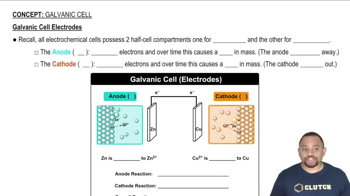
A voltaic cell generates electrical energy through spontaneous redox reactions. In this setup, oxidation occurs at the anode, where electrons are released, while reduction occurs at the cathode, where electrons are accepted. Understanding the half-cell reactions is crucial to identify which species is oxidized and which is reduced, thus determining the anode and cathode.
추천 영상:
가이드 코스
06:36
Galvanic Cell Electrodes

Standard Conditions and Nernst Equation

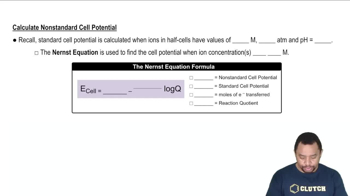
Standard conditions refer to a set of specific conditions (1 M concentration, 1 atm pressure, and 25°C) under which the standard electrode potentials are measured. The Nernst equation relates the cell potential to the concentrations of the reactants and products, allowing for the calculation of cell potential under non-standard conditions. This is essential for comparing the behavior of the cell under varying concentrations.
추천 영상:
가이드 코스
01:17
The Nernst Equation

Electrode Designation: Anode vs. Cathode

In electrochemistry, the anode is defined as the electrode where oxidation occurs, while the cathode is where reduction takes place. The designation of electrodes can change based on the direction of electron flow and the specific reactions involved. Understanding how to identify these electrodes based on the half-reactions is key to answering questions about the cell's operation and behavior under different conditions.
추천 영상: