Ch.20 - Electrochemistry
Brown - Chemistry: The Central Science 14th Edition
Brown14th EditionChemistry: The Central ScienceISBN: 9780134414232당신이 사용하는 게 아니라요?교과서 변경
20장, 문제 89

(a) What is electrolysis? (b) Are electrolysis reactions thermodynamically spontaneous?

검증된 단계별 안내
1
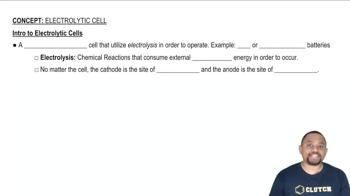
Electrolysis is a chemical process that uses electrical energy to drive a non-spontaneous chemical reaction. It typically involves the decomposition of compounds into their elements or simpler compounds.
In electrolysis, an external voltage is applied to a chemical cell, causing a redox reaction to occur. This process is the opposite of what happens in a galvanic cell, where a spontaneous redox reaction generates electrical energy.
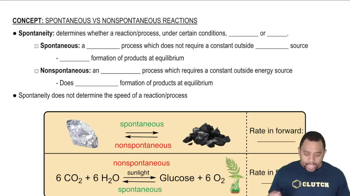
To determine if electrolysis reactions are thermodynamically spontaneous, we need to consider the Gibbs free energy change (ΔG) of the reaction. A reaction is spontaneous if ΔG is negative.
For electrolysis reactions, the Gibbs free energy change is positive (ΔG > 0), indicating that these reactions are not spontaneous and require an input of energy to proceed.
In summary, electrolysis involves non-spontaneous reactions that require electrical energy to occur, as indicated by a positive Gibbs free energy change.

주요 개념

질문에 올바르게 답하기 위해 반드시 이해해야 하는 핵심 개념들은 다음과 같습니다.

Electrolysis

Electrolysis is a chemical process that uses electrical energy to drive a non-spontaneous reaction. It involves the decomposition of a substance, typically an ionic compound, into its constituent elements or simpler compounds through the application of an electric current. This process occurs in an electrolytic cell, where oxidation and reduction reactions take place at the anode and cathode, respectively.
추천 영상:
가이드 코스
01:21
The Electrolytic Cell

Spontaneity of Reactions

A reaction is considered thermodynamically spontaneous if it occurs without the need for continuous external energy input. This is determined by the change in Gibbs free energy (ΔG); if ΔG is negative, the reaction is spontaneous. In contrast, electrolysis reactions are non-spontaneous, meaning they require an external energy source to proceed, as they have a positive ΔG under standard conditions.
추천 영상:
가이드 코스
04:20
Spontaneity of Processes

Gibbs Free Energy

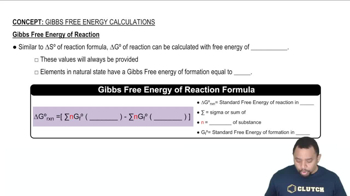
Gibbs free energy is a thermodynamic potential that measures the maximum reversible work obtainable from a thermodynamic system at constant temperature and pressure. It is a crucial factor in determining the spontaneity of a reaction. The relationship between Gibbs free energy, enthalpy, and entropy is given by the equation ΔG = ΔH - TΔS, where ΔH is the change in enthalpy, T is the temperature in Kelvin, and ΔS is the change in entropy.
추천 영상:
가이드 코스
01:51
Gibbs Free Energy of Reactions
관련 실천
교과서 질문

(d) Why are active metals such as Al obtained by electrolysis using molten salts rather than aqueous solutions?

540
views

교과서 질문

(d) Why is sodium metal not obtained when an aqueous solution of NaCl undergoes electrolysis?

403
views
교과서 질문

Iron corrodes to produce rust, Fe2O3, but other corrosion products that can form are Fe(O)(OH), iron oxyhydroxide, and magnetite, Fe3O4. (a) What is the oxidation number of Fe in iron oxyhydroxide, assuming oxygen's oxidation number is -2? (b) The oxidation number for Fe in magnetite was controversial for a long time. If we assume that oxygen’s oxidation number is - 2, and Fe has a unique oxidation number, what is the oxidation number for Fe in magnetite? (O)(OH), iron oxyhydroxide, and magnetite, Fe3O4. (c) It turns out that there are two different kinds of Fe in magnetite that have different oxidation numbers. Suggest what these oxidation numbers are and what their relative stoichiometry must be, assuming oxygen’s oxidation number is -2.

1236
views
교과서 질문

(c) What process occurs at the anode in the electrolysis of molten NaCl?

646
views
교과서 질문

Copper corrodes to cuprous oxide, Cu2O, or cupric oxide, CuO, depending on environmental conditions. (c) Copper peroxide is another oxidation product of elemental copper. Suggest a formula for copper peroxide based on its name. (d) Copper(III) oxide is another unusual oxidation product of elemental copper. Suggest a chemical formula for copper(III) oxide.

교과서 질문

Copper corrodes to cuprous oxide, Cu2O, or cupric oxide, CuO, depending on environmental conditions. (a) What is the oxidation state of copper in cuprous oxide?

939
views